Showing posts with label game design. Show all posts

Thursday, January 1, 2026

Hand-drawn deck for Scoundrel, the solitaire dungeon crawling game

Happy new year!

Yesterday I played a lot of Scoundrel. Scoundrel is a wonderful little solitaire dungeon crawling game, created by Zach Gage and Kurt Bieg. You can find the rules here (free PDF). The game is played with a standard deck of cards. E.g., a 10 of Spades is a monster of level 10, an 8 of Diamonds is a weapon with 8 damage, and so on. I drew my own minideck, with little images for all the monsters and items.

or from itch.io (it's free, of course),
cut it up & play!!

Have fun!

On the itch page, you can also download a template for you to draw your own deck.


And here's a list of the cards:


(Diamonds)

Weapons

(Hearts)

Health

(Spades)

Monsters 1

(Clubs)

Monsters 2

2

Dagger

Bandages

Skeleton

Goblin

3

Battle Axe

Soothing Ointment

Pixie

Cultist

4

Bow

8-hour Sleep

Ghoul

Mimic

5

Trident

Potion of Lesser H.

Killer Bees

Fishfolk

6

Scimitar

Potion of Greater H.

Giant Snake

Chaos Dwarf

7

Magic Wand

Antidote

Plant Monster

Moon Elf

8

Blunderbuss

Meditation

Smilodon

Ooze

9

Sword of Legends

Divine Intervention

Werewolf

Troll

10

Laser Rifle

Regeneration Vat

Mummy

Rival adventurers

J = 11

-

-

Ghost

Giant

Q = 12

-

-

Beholder

Evil High Priestess

K = 13

-

-

Lich

Hydra

A = 14

-

-

Elder Dragon

Mindflayer


Sunday, June 8, 2025

Rules for pulpy barbaric solo/CYOA games

Quick resolution rules for solo games. With a pulpy sword&sorcery feel. Quite likely this is all based on a misremembered version of a choose-your-own-adventure gamebook I'd read as a kid.

You are a barbarian warrior

Your name, gender and appearance are all up to you.

You start with 3 Might and 3 Luck Tokens. Keep a record of your maximum and current Might and Luck Tokens. You maximum Might raises as you level up. You can never have more than 3 Luck Tokens.

You start with 0 Experience. You level up at 12, 36 and 92.

You can carry one Weapon. You start with a Spear (Weapon Rating 5). If you haven’t got a weapon, you fights with your Fists (Weapon Rating 6).

You can have one Mount, which is usually a tamed beast or a vehicle. You start without a Mount.

You can carry up to three Items, five if you have a Mount. Your Weapon doesn’t count towards this tally. You start with no items.


Facing Danger & Combat

Life-threatening situations and enemies have a Danger Rating.

Roll a number of dice equal to your current Might. Optionally, you can burn a Luck Token to add an extra die.

In combat, any die that scores equal or over your Weapon Rating counts as a success.

In non-combat situations, a 5 or a 6 is a success.

Compare the number of successes to the Danger Rating:

Over

Triumph! Choose one Reward, or two Rewards and take a Wound.

Progress to favourable outcome.

Equal

Hard-earned victory. No Reward, or choose one Reward and take a Wound.

Progress to favourable outcome.

Less

Defeat! Take a number of Wounds equal to the enemy’s Danger Rating.

If you are still alive, progress to unfavorable outcome.


After resolving the situation

Lower your current Might rating by one for each Wound. A Wound can be negated by burning a Luck Token or losing your Weapon or an Item.

Add the Danger Rating to your Experience tally. If you reach a level-up threshold, raise your maximum Might and choose a Reward.


Rewards

Regain one Luck Token.

Regain one Might.

Gain Item or Weapon (if available).


Weapon Ratings

Unarmed combat

6

Common weapons

5

Rare and powerful weapons

4

There is no difference between ranged and melee weapons.


Items

Valuables. Catch-all category for all kinds of treasure & fancy objects. Each such Item can be used to barter for something else, bribe, reward or hire somebody, and so on.

Explosives/Magical Artifacts. Burn to achieve an automatic Triumph in a combat or use contextually.

Armor. Negate a single Wound after every combat. Only rolls of 6 count as success when resolving non-combat situations.

Shield. Burn to negate a single Wound after combat.


Foes & Danger Ratings

Regular foe, small group

1

Trained foe, medium group

2

Deadly foe, large group

3

Unusual power

+1


Approximate chance to achieve at least a Hard-earned victory:

Danger Rating

3 Might, WR 5

3 Might, WR 4

4 Might, WR 5

1

70%

87,5%

80%

2

26%

50%

70%

3

3,7%

12,5%

11%

4

-

-

1,2%


From "American Barbarian" by Tom Scioli


Monday, June 28, 2021

Demons & Diabolists: alternative Magic-User class and infernal entities for weird historical settings

I expanded the demonic True Name generator. Now you can roll domains of power, spells, and unique physical manifestations for the entities! And I wrote up a Diabolist class (for LotFP) that calls up and binds such demons (they basically act as the spellbook of the summoner).

The project is loosely based on The Lesser Key of Solomon, but instead of the high-level Dukes and Marquises of the demon kingdom it concentrates on the "footsoldiers" and "officers", the ones that a diabolist has a chance to summon AND control. I tried to strike a balance between evocative historical flavor and playability.

Download the PDF

(Prints as a nice little 8-page booklet)


Monday, October 21, 2019

Caryatids!

Somewhere in the city, there is a portico adorned with four caryatids. The locals are used to this sight, and just pass by every day, perhaps only stopping to admire the work of the forgotten sculptor. Now and then a woman, following an old tradition, whispers her deepest wish into the ear of the leftmost statue.
At night, the caryatids step off their bases. They patrol the streets, right wrongs, protect the innocent and the weak, hunt monsters and fight against dark-dark-dark magic.
But they must return to their place at dawn, or become an immobile statue – forever.

CARYATIDS!


OSR rules (based on LotFP) for playing benevolent animated statues in historical urban fantasy type settings! Inspired by this post, that old Gargoyles cartoon, China Miéville's Kraken and other weird urban fantasy stuff.

Caryatids as player characters

The Caryatids are statues animated by a mysterious force. Despite being of stone, their movements are fluid and precise, like that of a human – only much, much louder.
All Caryatids are HD 3
Hit points: by class, see below
Stats: rolled as usual
Base AC: 16
Base AB: +3 or by class, see below
Natural attack: d6
Skills: Caryatids start with a 3-in-6 chance in Architecture and Open Doors; and a 1-in-6 chance in Stealth (which they can employ to muffle their otherwise very loud movements)

Saves:

Paralyze
Poison
Breath
Devices
Magic
12*
8**
12
14
8
* “Turn-to-stone” effects can render Caryatids immobile
** Caryatids are, of course, unaffected by poisons, but corroded by acid

Progression:

Caryatids don’t level up. Their attributes can only increase through magic, the help of artisans, or other in-game ways.

Movement and Encumbrance:

Caryatids move as unencumbered humans, can climb, jump, etc.
All movement is loud and noticeable. With a successful Stealth skill check, a Caryatid can move with less noise (but still audibly). Only the Maiden Caryatid (see below) can use her Stealth skill to move unnoticed.
Caryatids can carry twice as more as a human.
Caryatids sink in water, but can walk once reaching the bottom.
When standing still, Caryatids are indistinguishable from a statue.

Damage & hazards:

Bludgeoning weapons deal damage as normal.
Slashing and piercing weapons deal 1 damage, flat.
Natural perils only affect them if they would affect a statue – Referee’s discretion (e.g. stone statues can crack at high temperatures or if water freezes in their crevices).
Magic attacks deal damage as normal.

When a Caryatid drops to 0 hit points, roll 1d6 to see which part gets shattered. Any further damage triggers a new roll on the chart until total destruction.
1-2
Arm; if both arms are destroyed, see next result:
3-4
Leg (-10’ Movement); if both legs are destroyed, see next result:
5
Torso fractured (-1 HD, adjust maximum hit points and attack bonus);
if HD drops to zero, see next result:
6
Head = total destruction

“Healing”:

HD represents the actual structural integrity of the stone body. Caryatids can regain HD only if restored by a highly skilled human artisan or magical means.
Hit points are the force that’s animating the stone body. Caryatids can regain hit points through the Matron’s healing spells and by “resting” during the day; however these options never restore HD.

Classes:

Although visually similar, each the four caryatids each represent an individual class:

The Matron

Hit points: 3d8
Spellcasting as Cleric 3

The Amazon

Hit points: 3d10
Attack bonus as Fighter 3
Natural attack: d8

The Witch

Hit points: 3d6
Spellcasting as Magic-User 3

The Maiden

Hit points: 3d6
Skills as Specialist 3 in addition to the base Caryatid skills


Saturday, May 11, 2019

1d8 curses


  1. All your clothes, personal items and rations get covered in mold over the time. It can be cleaned off, but regrows in a couple of days until the curse is broken.
  2. When you want to pay for something, you always somehow have one copper coin less than the needed amount. This comes into effect only in the exact moment of "transaction" - after you first agree upon or learn the price of an item or service and want to hand over the money, you realize there is one copper coin less. You cannot access any of your "other" money at this point. You have to barter, beg or borrow.
  3. Food and drinks taste foul to you. The disgust can be overcome, but then you won't be able to tell whether something you consume is fresh, rotten, good, bad, acidic, etc. You do worse on saves against ingested poisons.
  4. Tinnitus, but each time you get used to it, it changes in pitch or intensity, leading to renewed confusion.
  5. People can't remember your name. They call you something else, or mix up letters. Slowly, you name erodes, and you yourself forget it. If you take another name, it is effected by the curse as well.
  6. Your appearance becomes the go-to iconography when depicting a "bad person" (like a sinner in a biblical scene, a barbaric enemy in a battle, a criminal on a wanted poster). You start to be randomly represented in art pieces (paintings, drawings, tapestries, woodcuts, stained glass, and so on). Soon people subconsciously associate you with the "bad" you represent in these pieces.
  7. Cats actively hate you. They never attack directly, but exhibit passive-aggressive behavior and plot murder.
  8. Constant nagging discomfort. There is always a stone in your shoe. You get the bumpy bed and the creaky chair. Your wet clothes never dry properly. Everything is slightly off.

Random generator button:


Friday, April 12, 2019

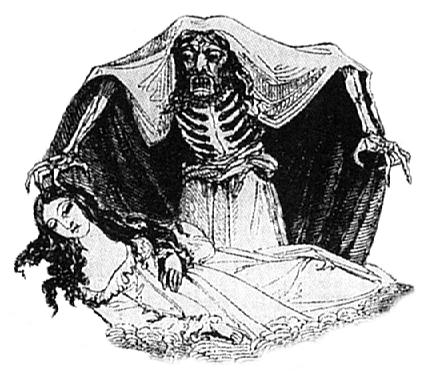
[Monster] The Bulbous Ones, for the Harry Clarke Project

This is an offering for Emmy Allen / Cavegirl's Harry Clarke Bestiary Project.


THE BULBOUS ONES
Fletcher / Gambi / Radish
No. Appearing: Unique trio of entities
Armor Class: as Leather / as Unarmored / as Leather
HD: 4 / 6 / 4
Move: half human / one quarter of human / human
Attacks: 1 blades of grass (d6) / 1 primal scream (d8) / 1 soft whisper (d4)
Save as: Specialist 4 / Cleric 6 / Elf 4
Morale: 12
Treasure Type: None
Alignment: Lawful

Here they are, the Bulbous Ones: Fletcher, Gambi and Radish. Leeches born from the primordial soup, three minutes after Creation, everyone’s younger siblings and servants. They speak the Ur-Language, consume the darkest secrets, and spew forth even darker ones.

Go out at night to the swamp, inhale the stench, dig a hole, and whisper a dark secret into it. Then the Bulbous Ones appear, and serve their summoner for 3 nights in a row. At the end of each night, the summoner must dismiss one of the three by giving it its coveted object. At the end of the last night, the summoner must appease the last one with the blood of an ox before dismissing it with the final gift.

Fletcher was three, then two, then one. Sinuous bodies coiled together. Can see through walls and into other dimensions. Fletcher’s coveted object is twelve twigs, eleven plums, ten ice shards, nine grains of rice, eight breaths of fresh air, seven kisses; all crushed in a mortar and fed to a pig.

Gambi smiles and bubbles. The smile is the smile of knowledge, as Gambi remembers all the secrets that were ever whispered to summon the Bulbous Ones. Gambi’s coveted object is an ivory chair with five legs.

Radish moves through the air with peculiar grace, in a dance akin to the flow of water. Traces magical resonance. Once traced, the resonance can be manipulated, replicated, consumed. Radish’s coveted object is a crystal that grows under your molars.


Art by Harry Clarke, text by Tamás Kisbali


Creative Commons License
This work is licensed under a Creative Commons Attribution 4.0 International License.

Friday, March 15, 2019

Variations on Vampiric Drain


Some ideas on modelling "draining" attacks in old school games:

Attribute Drain

The drain targets and changes an attribute. Bloodsucking usually decreases physical characteristics, energy drain or psychic vampirism affects mental characteristics, but it's always interesting to have unusual leeching, e.g. if your system has a Luck attribute, why not drain it?
There are a couple of different ways to do it mechanically:

  1. Decrease the attribute by a numeric value (1, or roll a dice). Recalculate modifier and any related secondary attributes.
  2. Bump the attribute down to the next modifier level. E.g. if the character's Strength attribute gives them a +2, lower it to the closest value that would give only +1. Then 0, -1, -2, -3. -3 is bumped down to death. (I think I took this from the LotFP Referee Book)
  3. Re-roll the drained attribute using the standard character generation method (e.g. 3d6). Take the lower result. Recalculate modifier and any related secondary attributes.
  4. If your system doesn't have a designated Luck attribute, but you want to model the draining of a character's "luckiness", how about applying a negative modifier to attack roles or Saves?

Advanced Psychic Vampirism

A psychic drain can either target an attribute (see above), or change some other "mental" thing.

  1. Draining the spellcasters: 
    • An ability that gives the caster spell usage is affected, e.g an unused spell slot becomes expended or spell points are drained.
    • A memorized or prepared spell is erased from the mind of the victim for the day. A more severe version is removing the ability to prepare a spell at all (the spell might be re-learnt with effort).
  2. Draining the Clerics:
    • Mwhahahaha... 
    • Remove the ability to Turn Undead for a set amount of time (based on the HD of the draining creature).
    • Disable or reverse certain Clerical spells for a set amount of time (based on the HD of the draining creature). Forcing reversal is an interesting choice: fluff-wise, for example it makes a "good Cleric" a vampiric agent: cannot cast Cure Wounds, can only inflict pain, healing spells become curses and so forth.
  3. Non mechanic-based draining:
    • Drain memories: the character forgets something. The higher the HD of the draining creature, the more important is the memory. It can be a personal memory, or a piece of knowledge, depending on the flavor of vampirism.
    • Drain "capability": the character forgets a learned/trained/nurtured skill, like fancy fencing moves, riding a bicycle, swimming, arithmetic, etc.

Level Drain

A classic! Feared by everybody. Perhaps too severe to some DM's tastes. You can try draining experience points instead (e.g. creature HD x 1d10 x 100 ?), or model the loss of "experience" by draining memories and skills, as above.

Parasitism

The effect isn't constrained to a one-time drain. The creature latches on to the victim, forms a bond or channel between them (this can be physical, but also psychic, sympathetic, magical). Through this channel, the creature can constantly feed on the victim even when they are not present. This connection stays until severed by magical means or until the initiating creature is destroyed.
Some possible effects:
  • The victim cannot naturally heal.
  • Once in a given period (week, month, during every full moon) the victim suffers the effect of the drain, e.g. loses hit points, loses an attribute point, or suffers memory loss.
  • The victim is drawn to the creature (classic vampirism!)
The parasitic connection can have a visible / detectable sign on the victim (change in skin or eye color, clothing preferences, sunlight sensitivity, mental disturbance, sickness, etc.).

Withering & Weakening

Draining hit points ( = doing damage) is okay, but perhaps kinda boring? Weakening attacks can target Constitution too. I personally like using the HD attribute in various ways. For example:
The drained character must immediately re-roll all their hit dice. Constitution modifier applies only if it's negative. Take the new value if it's lower than the previous maximum hit points. Current hit points drop down to equal the new maximum or remain unchanged if already lower.

Aging

The victim rapidly ages. Roll a number of d10's equal to the HD of the draining creature. The total is how many years the victim ages. For each full 10 years, the victim loses 1 point of Dexterity. For each full 20 years, the victim also loses 1 point of Constitution.

Benevolent Leech

The bloodsucking creature drains 1d6 hit points worth of blood. If the victim is diseased, poisoned or has a similar ailment, they may roll a Save against Poison with a bonus equal to the amount of hitpoints drained; on a success, the victim is cured of the condition.
Alternatively, a psychic vampire takes away insanity, nightmares, etc.


Wednesday, March 13, 2019

Suspirian School of Ballet

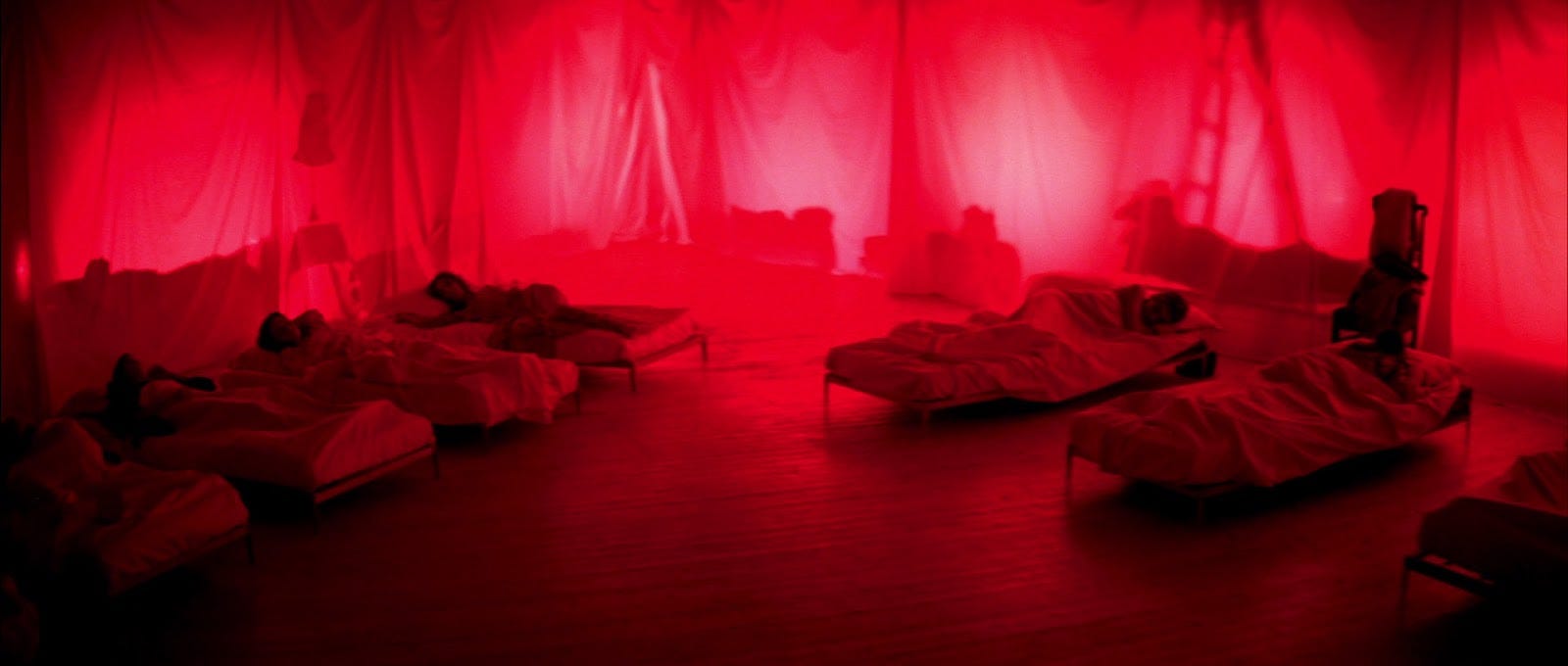
How about a procedurally generated dungeon (akin to The Gardens of Ynn & The Stygian Library) set in the surreal and murderous dance school of the 1977 Suspiria?


During the day, the Suspirian School of Ballet (or the Chthonic Academy of Choreography?) is a tough place, where you have to put up with the cruelty of the teachers and the other aspiring ballerinas.

But at night... everything changes to even worse. You wake up screaming and sweating in your dormitory, only to find that the building is completely different. Corridors twist into a maze of madness, new rooms or macabre dimensions and unfathomable purposes appear. Unnatural lights shift around, and the curtains sway in the air as thousand phantoms. Shadowy silhouettes on the walls chase after you.

Somewhere in the very heart of this labyrinth is the Source of it all, a terrible, terrible secret... To escape this madness, you must find it and fight it.

Gameplay


Nighttime

Nighttime is crawling the vast labyrinth of the School. Only the Dormitory is fixed. Every night all other locations are generated randomly.

One exclusion: the characters can form a bond to a Nighttime location or encounter, to make it permanent and revisitable. Perhaps it's a dead girl's ghost who wants revenge. Or a hallway where healing water is tricking from the statue of a nymph. This has a cost: any place or entity the characters are bonded to will attract the attention of the unkind forces of the school.

This exclusion mechanic lets the players to define little goals or quests for themselves.

Daytime 

Daytime is downtime. Lick your wounds. Survive the torturous dance lessons. Find new weapons and do research in the library. Nighttime events bleed into the day, and each time you bring back more and more darkness. But perhaps certain Nighttime encounters are solvable from this side (kill the teacher who bullied that girl into suicide?).

Locations


  1. "Normal" areas of the School, but twisted by the unkind forces (school rooms, offices, halls, staircases, dance rooms, bathrooms, library, cafeteria, dormitories, storage rooms, small gardens, orangeries...)
  2. What was here before the School (Inquisitorial torture rooms, prison cells, dungeons, magic laboratories
  3. Nighttime-born areas, lairs of the unkind forces, intrusions from other dimensions

Illumination


One of the strongest visual driving forces of Argento's Suspiria is the use of lush, baroque, unnatural lightning in each scene. I think it's possible to implement this in the game as well.
In each location, the Referee rolls for random illumination. This color influences what events or encounters happen, and how they play out. Some locations or circumstances call for two or more illumination rolls, and the influences bleed together.

  1. RED is blood, aggression, death
  2. PURPLE is madness and witchcraft
  3. GREEN is poison, mutation, sickness
  4. YELLOW is pain and torture incarnate
  5. BLUE is deception and lies
  6. DARKNESS is the Void you wish you could fill with any of the above


Encounters

  1. Ghosts of pupils tortured and bullied to death
  2. Mean girls
  3. Living shadows
  4. Phantom force
  5. Dancing plague
  6. Black-Gloved Killer
  7. The Witch

Ideas for Extra Flavor

  1. Language of sighs & whispers
  2. Blades signal death
  3. Spells contained in shards of stained glass

There's a lot to work out here, but at least I jotted down some basic ideas. Emmy Allen's stuff is a constant source of inspiration for me, and so are horror movies, weird fiction... I think this combination could work pretty well.