Saturday, March 10, 2018

Sir Leo Wooldrich, occult investigator

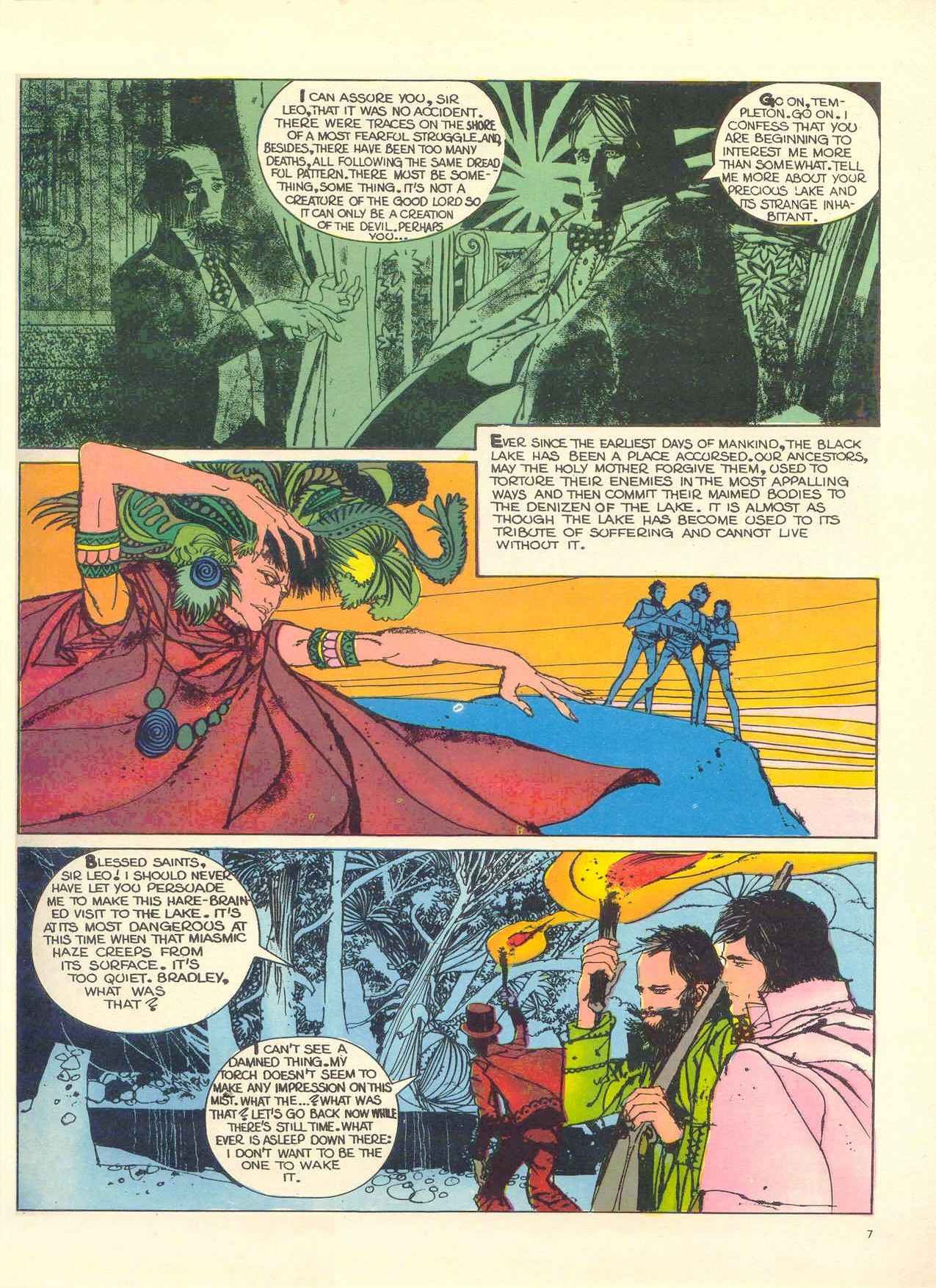
In the early 1970s, there was a comics magazine called Dracula. It featured Spanish comics translated into English. Not about Dracula, though. They featured original genre / pulp heroes, like the sword & sorcery warrior Wolff, the sword & planet / science fantasy Agar Agar, and Sir Leo, "an English aristocrat - a hunter of evil. A man whose life is dedicated to the destruction of those nameless horrors that threaten mankind".

The stories were all presented with lush psychedelic art, swirling colors and grotesque imagery. Personally, I really dig the fusion of horror with trippy 1970s aesthetics (Dracula AD 1972 will always be dear to me...)

The stories about Sir Leo (or Sir Leo Wooldrich) were drawn by José Beá, and, damn, they look amazing!!


Wednesday, February 21, 2018

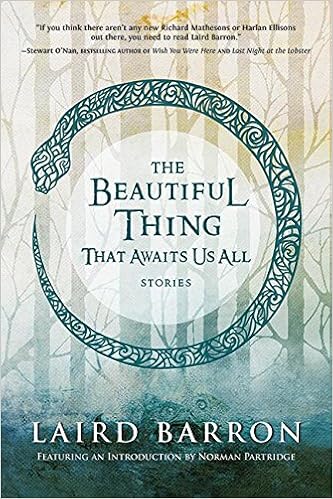
[Laird Barron] The Beautiful Thing That Awaits Us All


Overall, this is a very strong collection, and it's the one that really got me into Laird Barron.

Blackwood's Baby --- Hunt goes horrific for this hardboiled (anti-)hero, Luke Honey. The story has some formulaic elements, but they all come together very nicely.

The Redfield Girls --- This is a change from most of Barron's stories, as the protagonists are not gritty pulp men-of-action, but a "close-knit sorority of veteran teachers", who rent a house by a lake. Strange hauntings occur.

Hand of Glory --- One of my favorites in this collection. Back to a Barronian hardboiled narrator, a 1920s mafia hitman, who ends up being the pawn in a war between various occult factions. Barron even ties in Eadweard Muybridge into the conspiracy, to great effect.

The Carrion Gods in their Heaven --- Another good one! Two lovers hole up in a cabin in the woods... but what lurks in the darkness? Once again, Barron takes a formula, but gives it a couple of twists, and ends up with a great story.

The Siphon --- An interesting story, with some imagery lifted from modern techno-thriller, but in the end going back to the occult roots.

Jaws of Saturn --- A very strong story. I like it how many of Barron stories feature similar characters, return to the same locations, but instead of being repetitive, they explore these from different points of view and reinforce the horror. Some of the best apocalyptic imagery in Barron's oeuvre here.

Vastation --- Stream of (cosmic) consciousness! I love this mess of post-apocalyptic sci fi horror something.

The Men from Porlock --- Back to the 1920s; this action story pits a group of lumberjacks against a weird cult (The Children of Old Leech, of course). I once made a hex-map interpretation of this piece. Ties in strongly with Barron's novel, The Croning.

More Dark --- Hard to comment on this one. I like the moody writing, but I don't care about the meta-fiction aspect (this story is about Barron and his horror author mates hanging around at a con, waiting for Ligotti to make an appearance).


Thursday, February 15, 2018

[Laird Barron] Occultation & Other Stories

2010


The Forest -- Creepy & crawly, Barron at his best. Also, a good one to go back to from time to time, as it features the recurring mad scientist duo, Toshi and Campbell. Weird science horror with a very personal line.

Occultation -- The title story is actually one I don't care about much. It's not bad, though, two young rebels hanging out in a motel room; eerie horror ensues... Get Gregg Araki to direct!

The Lagerstätte -- An amazing story about loss. Death of a loved one, and how to cope. The imagery of the Lagerstätte (pitch-black mineral deposits) that everything is sinking into keeps haunting me. Reminds me of the "tomb world" from Do Androids Dream of Electric Sheep?...

Mysterium Tremendum -- Enter the Black Guide, the most important tome of eldritch lore in Barron's cosmos. Hiking trip goes w r o n g. "There aren't any goddamned dolmens in this part of the world", yeah, right... Lots of connections with Barron's novel, The Croning.

Catch Hell -- Creepy black magic ritual story. Rosemary's Baby style.

Strappado -- Another favorite, once again proving that the darkness is best conveyed through personal / psychological horror. And another take on the theme of loss, survivor's guilt, and so on.

The Broadsword -- A long, slow-burning story of transformation. The Broadsword is a great locus of the Barronian world, a decrepit hotel building, where weird things happen (of course). It features in several stories.

--30-- -- This is a story about two scientists working in a creepy wilderness area (once a place of cult activity). Can't wait to see the movie adaptation, They Remain!

Six Six Six -- Okay, this is another story I keep forgetting. I wrote up --30-- and published the post, and then realized there's one more entry in the collection... I can barely remember a thing about it. It feels like a faint afterthought to a strong collection. But maybe I just need to re-read it!


Reviews/write-ups by other people:
Stomping on Yeti
Oddly Weird Fiction
Skulls in the Stars

Tuesday, February 13, 2018

[LotFP & the rest] Weirding up Sleep?

Sleep is another staple. Arguably, one of the most oft-employed level 1 spells. So... how can you make it weird?

Sleep and dream
The first and most obvious way is to connect Sleep to dreams and dreaming, perhaps even Dreamworlds?


  1. Creatures affected by the Sleep spell see the caster's most recent dream,
  2. ...or the caster's worst nightmare,
  3. ...or the caster's sweetest fantasy wet dream.
  4. Creatures affected by the Sleep spell relive their own most recent dream / worst nightmare / sweetest dream.
  5. Creatures affected by the Sleep spell enter a dreamworld, unique to the caster. They can act actively for the same amount of turns their corporeal bodies are under the glamour. During this, they can basically wreak havoc inside the caster's mind, emprint themselves into her/his dreams, and so on.
    Of course, this last option is a mini-game in itself, and you don't want to waste time doing this every time somebody casts Sleep. But it can be an interesting one-off effect of this staple spell.

[Laird Barron] The Imago Sequence and Other Stories

Laird Barron is probably my favorite contemporary horror author. I love his style, I love his themes. I devour his works with my gaping maw, or something to that effect. I keep re-reading his collections and novels, hunt down anthologies with his work.

Unfortunately, despite (or due to) my unruly appetite, sometimes I forget which story is in which collection, or mix up titles... Talk about short attention span (although the taste & aftertaste of his stories lingers for long).

Thus, I've decided to go through some of his books and write up my thoughts. Maybe the information will stick better this way.

My first exposure to Barron's work was his third collection, The Beautiful Thing That Awaits Us All, but let's do this in order of appearance instead.

Warning: some spoilers, but I'll try to hide them.
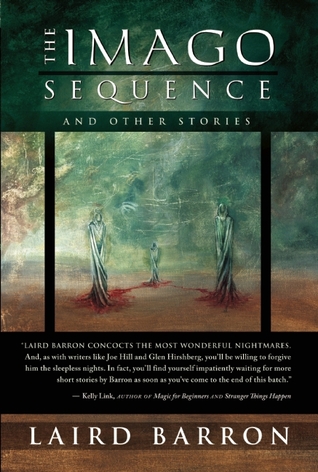
2007

Old Virginia -- For some reason, I'm not too keen on stories featuring military protagonists. Give me a private detective or a mafia hitman anytime, but spare me the officers. This story is covert military ops meets MK ULTRA meets Baba Yaga. A solid story, but not one of my favorites.

Shiva, Open Your Eye -- Told from the viewpoint of an eldritch abomination wearing human flesh. Tons of evocative cosmic horror passages. I read this story as a set up Barron's main recurring entity, the Old Leech... Also, the part when the narrator shows what's in his barn: I envision it as an episode from the Hannibal TV series.

Procession of the Black Sloth -- Oooh, I love this one. A meandering, hallucinatory slow-burner set in Hong Kong. Ennui, decadence, terror. Your mileage may vary, but I love this combination.

Bulldozer -- I didn't care much about this one at first, but it grew on me! The story is based on Barron's favorite theme: hard-boiled hard-knuckled antihero going up against something with terrible consequences. Pulp western horror.

Proboscis -- Meh... Some good details, but this story just doesn't come together. More hard-knuckled dudes (this time in a modern setting), menaced by an unknown (and unknowable) force.

Hallucigenia -- This is the most terrifying story in the collection. There is supernatural horror all right, but the worst part that really gets to you is the simple human terror of looking after a paralyzed loved one. Not for the fainthearted.

Parallax -- I've seen this story get lots of praise. It is intricately woven and masterfully disjointed. But I can't get into it.

The Royal Zoo is Closed -- This is a story I read, then instantly forget.

The Imago Sequence --  Another one of Barron's "tough guy vs. cosmic horror" stories, this time done extremely well. The narrative structure is more traditional, but creepy and hard-hitting nonetheless.


See also the write-ups by oddlyweirdfiction.com for a different take!
Saturday, February 10, 2018

[Inspiration] The unfathomable cosmic horror of peer-reviewed journals

When you have exhausted your black metal music library to create Vaginas Are Magic!-style spells, why not turn to the time-honored and peer-reviewed field of scientific journals for inspiration?!

Coming soon, the maddening rituals of...


Add these to Space Age Sorcery v.2, please.


(of course, psychedelic cosmic black metal is still indispensable!)


Friday, February 9, 2018

[LotFP & the rest] Weirding up Cure Light Wounds?

It can be interesting to take a good ol' spell that everybody knows and uses, and thinking of ways to make it more weird. I mused about Mirror Image recently, so let's take a look at something else.

Cure Light Wounds is a staple Cleric spell in all iterations of D&D and OSR games, the main reason for "bringing the Cleric along", and so on. There are advocates of getting rid of this spell (and other instantaneous healing effects, like health potions, etc.) to facilitate a more perilous, horrific game environment, where hazards are more "real", because you cannot rely on a quick and easy method of getting those meager amounts of HP back.

Now, I was thinking about making healing spells more interesting. My main line of thought is to make them stand out, make them significantly different from "natural healing". A couple of ideas:


  1. Healing spells leave weird scars. Geometric patterns. Scabs in the shape of occult sigils. They mark the healed person as an object of witchery.
  2. The accelerated supernatural healing process doesn't get rid of foreign objects (arrowhead, bullets, etc.), but incorporates them into the healed person's body. This might lead to medical complications later on...
    So, magical healing as mutation. Turn this up to eleven -- magical healing is body horror! Make sure you drop your weapon, otherwise you risk fusing with it when the Cleric heals you!
  3. And generally, subverting magical healing is an awesome way to horrify your players. If you are using Taint or Corruption like mechanics, make magical healing a source of this malevolent effect. 


Thursday, December 28, 2017

[Swamp '70] George Rodrigue paintings

The paintings of George Rodrigue (1944-2013), depicting life in rural Louisiana have an eerie, haunting quality to them... Definitely inspiring. Check out the site of Wendy Rodrigue (the artist's wife), it has background info on several paintings.

Aioli Dinner (1971)

Doc Moses, Cajun Traiteur (1974)

"A traiteur is a Cajun folk doctor with a special, inherited gift for healing one ailment. In George’s painting, Doc Moses heals earaches. He pours a ring of salt around the patient and touches his ears. Amazingly, only the healer must believe. The patient’s skepticism does not affect the cure." (source)

The Cajun Bride of Oak Alley (1974)

"In 1850, on the occasion of the simultaneous weddings of his two daughters, Durand’s slaves decorated the arboreal alley in a manner befitting his most eccentric nature. Prolific web-spinning spiders were brought in (some say from the nearby Atchafalaya Basin, others say from as far away as China) and were released in the trees to go about their arachnidan business. Then slaves went to their task of coating the dewy, billowing webs with gold and silver dust blown from bellows. And under this splendidly shimmering canopy proceeded the ethereal promenade of the wedding party and its two thousand guests." (source)

Wednesday, December 6, 2017

[LotFP] Musings on Mirror Image

Mirror, mirror...


In Lamentations of the Flame Princess the classic Mirror Image spell it is given an interesting twist:

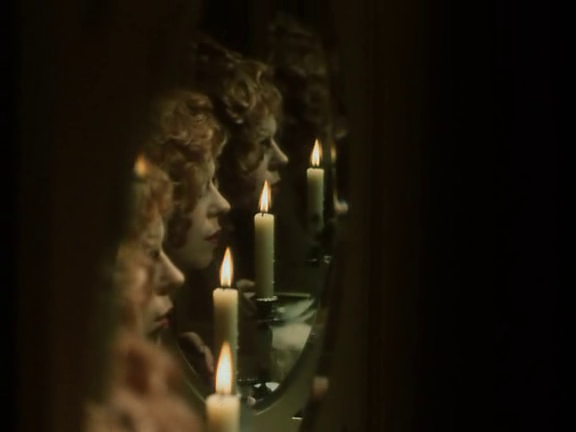
"This spell grabs 1d4 duplicates of the caster from near-identical timelines to confuse foes and make it more difficult for the original caster to come to harm. Since all of the mirror images are the caster, in the same situation and fighting the same battle in their own timeline, they are indistinguishable in every way from the caster and mimic his every motion." (LotFP: Rules & Magic, p. 117)

In other D&D variants* Mirror Image is usually treated as an illusion spell. Which is fine, but for reasons of WEIRD, the LotFP version holds many possibilities, reaching behind the mere use of the spell.

Magic is supposed to be dangerous, and have serious consequences, right?

If the mirror images are real people (from a different timeline), forced to appear next to the caster by foul sorcery, then when they die or take damage in their stead, well, that's real death and damage. Not many Magic-Users realize this dark feature, that by using Mirror Image as a parlor trick or to get out of some mundane trouble, they are actually eradicate themselves from "1d4 timelines".

So, if a Magic-User in your game casts Mirror Image often, as a Referee (DM) you can certainly introduce some creepy weird elements. Have the "eradicated alternatives" haunt the Magic-User in his/her dreams, or just flicker in and out of existence in their field of vision.

And what if the alternative timeline self casts Mirror Image? Does the Magic-User from your game get siphoned into the alternative timeline for the duration of the spell?

These are also good ideas for a Mirror Image miscast table...


___________________________

* At least to my knowledge, this variation is included only in LotFP. Correct me if I'm wrong.


"Which version of myself should I kill today?"

Monday, November 20, 2017

Contacting unnameable cosmic forces

"Then, toward midnight, the necromancer arose and went upward by many spiral stairs to a high dome of his house in which there was a single small round window that looked forth on the constellations. The window was set in the top of the dome; but Namirrha had contrived, by means of his magic, that one entering by the last spiral of the stairs would suddenly seem to descend rather than climb, and, reaching the last step, would peer downward through the window while stars passed under him in a giddying gulf. There, kneeling, Namirrha touched a secret spring in the marble, and the circular pane slid back without sound. Then, lying prone on the interior of the dome, with his face over the abyss, and his long beard trailing stiffly into space, he whispered a pre-human rune, and held speech with certain entities who belonged neither to Hell nor the mundane elements, and were more fearsome to invoke than the infernal genii or the devils of earth, air, water, and flame. With them he made his contract, defying Thasaidon's will, while the air curdled about him with their voices, and rime gathered palely on his sable beard from the cold that was wrought by their breathing as they leaned earthward."
 "The Dark Eidolon" by Clark Ashton Smith

Wonderful passage from a wonderful story.