Showing posts with label 17th century. Show all posts

Tuesday, March 1, 2022

Lamentable Blades: swashbuckling combat house rules for LotFP/OSR games

This is a set of house rules for swashbuckling combat, dueling and mustache-twirling. Based on LotFP, but usable with any similar OSR game or B/X clone like Old School Essentials or whichever you prefer. Main features: Armor Class is replaced by a Defense Class based on the character's Hit die type, because swashbuckling characters rarely wear heavy armor or armor at all. If you are not happy about your Defense class or Initiative, you can reverse them as an action. There is a reaction-like Repost available & quick-and-easy rules for wrestling

Basically I wanted to do a mash-up of LotFP and Flashing Blades: add some attack options, but without bogging down combat.

Read the rules in this post or grab the free/PWYW PDF over at itch.io!


Buccaneers #19


LAMENTABLE BLADES

House rules for Lamentations of the Flame Princess. For 17th-18th century dueling, swashbuckling and moustache-twirling.

Stats

Initiative = d6 + Dexterity modifier, rolled individually at the beginning of combat (but an action can be used to invert it)

Attack bonus = base attack bonus (according to class and character level) + attribute modifier (based on weapon type: Strength or Dexterity)

Defense class [replaces Armor class] = 10 + Dexterity modifier + the character’s Hit die (Fighter d8, Cleric/Specialist d6, Magic-User d4), rolled at the beginning of combat (but an action can be used to invert it)

Combat

At the beginning of combat, everybody involved rolls individual Initiative and Defense class.

Actions/Maneuvers

At the beginning of each round, declare actions in reverse initiative order. One can also declare whether they are taking an aggressive or defensive stance.

If unsatisfied with the Initiative or Defense class rolled at the beginning of combat, there are two options:

Improving Initiative

The character forfeits all other actions and attacks, and concentrates on acting earlier in the next round. Invert the character’s Initiative roll (if the character rolled 1 on the d6, it becomes a 6, 2 becomes a 5, 3 becomes a 4). During this round, the character is assumed to have taken a defensive stance. The new Initiative activates on the next round.

Improving Defense class

The character forfeits all other actions and attacks, and tries to regain balance, gain a foothold, cover their rear, etc. Invert the character’s Defense class roll (if the character rolled 1 on a d6, it becomes a 6, 2 becomes a 5, 3 becomes a 4, etc., depending on the Hit die). During this round, the character is assumed to have taken a defensive stance. The new Defense class activates on the next round.

Attacks

The combat roll is a d20 plus the character’s Attack bonus and any modifiers (from chosen tactic, situational advantage or disadvantage, encumbrance).

Combat modifiers


Situation

Attack bonus

Defense class


Notes

Charge/Momentum


(…swinging on a chandelier, jumping down from a balcony…)

+2

-2

Successful attack causes damage and knocks down the enemy for 1 round. Unsuccessful attack causes the attacker to lose balance instead. Levelled characters can save against Paralyzation.

Aggressive stance

+2

-4

-

Defensive stance

-4

+2

-

Off-hand parry weapon

*

+1

Additional +1 on disarming attempts

Off-hand offensive weapon

*

0

Roll damage for both weapons, take higher result

Armor worn

-1

-1

-1 damage to wearer


Simple attack

Make a combat roll. If the result is equal to or greater than the target’s Defense class, the attack hits and does damage. Damage is defined by the weapon used and adjusted if the target is wearing armor.

Multiple attacks

This type of attack is only available if a levelled character is facing off against two or more “mooks” (0-level enemies). Instead of making a single one, the character gets a number of combat rolls equal to their level. Each such maneuver (simple attacks or disarms) must be directed against a different enemy, and each attack is made as if the attacker was level 1.

Riposte

The target of an unsuccessful attack might follow up with a riposte. Only one riposte can be made in one round. It is rolled either as a simple attack or a disarming maneuver. An additional +1 bonus applies if the original attack was half or less than half of the target’s defense class. Ripostes don’t have to be declared.

Disarm

Make a combat roll. If the result is equal to or greater than the target’s defense class, the disarming maneuver is successful. An off-hand parrying weapon grants +1 on the disarming attempt.

Stun

Make a combat roll. If the result is equal to or greater than the target’s defense class, the target is stunned and cannot act for a number of rounds (1 round for unarmed attacks and bladed weapons; a number of rounds equal to the damage rolled for blunt weapons). However, only a flat 1 damage is dealt to hit points. Levelled characters can save against Paralyzation to avoid getting stunned.

Facing multiple foes

Defense class is unadjusted if the number of “mooks” is equal to or less than the target character’s level (or group of characters combined level). Otherwise, there is a -1 penalty for each attacker over this number. When levelled characters or monstrous creatures attack, total their levels or hit dice and compare with the target.

Unarmed combat

Punch/Kick

As a simple attack, does 1d2 damage plus Strength modifier. Can be used to stun an enemy or attack multiple enemies.

Wrestling/Overbearing

Everybody involved in the brawl rolls all their Hit dice and adds their Strength modifiers; totals are compared; higher wins. The next round the struggle continues, however the last round’s losers subtract one from their effective hit dice. If any of the sides has no Hit dice left, they are completely subdued.

Being equipped with a net, rope, man-catcher or anything similar grants an additional die on the roll.


House rules to use in conjecture with Lamentations of the Flame Princess: Rules & Magic. This product is an independent production by Tamás Kisbali/Eldritch Fields and is not affiliated with Lamentations of the Flame Princess. Lamentations of the Flame Princess is a registered trademark owned by James Edward Raggi IV.

Art taken from Buccaneers #19 (Jan. 1950), now in the Public Domain.


Sunday, January 30, 2022

1d10 carousing mishaps for Three Musketeers campaigns

Our LotFP campaign is moving to Paris, to play Terror in the Streets. We're gonna play as D'Artagnan and the Musketeers! Our Referee, as per usual, crowdsourced a carousing mishaps table from us, these are my 10 entries:

  1. You and your carousing mates go on a wild carriage ride. Save against Paralyze to see if you can hang onto the speeding vehicle. If you fall, take d6 damage. If you stay on, the coachman is so impressed, you get a free day of service (access to a four-wheeled coach with two horses for a full day).
  2. You save a young boy or girl from trouble. Turns out, they are a junior member of the thieves’ guild and owe you a minor favor: this can be some information, or stealing a small thing for you. You can always find the person hanging out around the Cour des miracles.
  3. Referee’s eyes only! Somebody plays a trick on the character. The character’s weapon is replaced by a poor-quality copy. It breaks on the first attempt to use it in a fight.
  4. You get into a fight with the Cardinal’s Men: it’s a good ol’ brawl, with improvised weapons. The fight ends in a draw, but you get to keep your improvised weapon, roll d6: 1 leg of lamb (1 tasty ration), 2 leg of chair, ornately carved (club with d6 damage or worth 10 sp), 3 mop or broom, 4 silver tray (usable as small buckler or worth 50 sp), 5 chain that used to hold a chandelier, 10’ long, 6 bottle of wine, miraculously not broken during the scuffle (magic item, bottle made out of unbreakable glass).
  5. You get into a fight with the Cardinal’s Men. You challenge their leader to a duel. Roll d6, the fight is: 1 to the death, 2-4 to the first blood, 5-6 to disarming. You are too drunk to gauge your opponent’s skill, but they might be lower or higher level than you. If you back out, you are a coward and Reactions to you are at -2 in this city. If you agree, roll initiative and fight (Fighter [carousing character’s level+2-d4]).
  6. You get into a fight with the Cardinal’s Men and fall into a trough. Everybody laughs at you, news spread quickly. You and your whole group gets -1 on Reaction rolls this session.
  7. You get into a fight with the Cardinal’s Men (of course). No blood is shed, but they slice up all your fancy clothes. You go back home and change into your second set of clothes (if you have one), and on the way back you get into a fight with a rival Musketeer (you both have your eyes on the same beautiful lady/handsome lad). No blood is shed, but your clothes are ruined AGAIN. Next you borrow a shirt from a comrade, but get into a scuffle with a trash racoon, and the animal tears the shirt into pieces. THIS IS A CURSE. THIS SESSION IF YOU PUT ON CLOTHES, THEY TEAR OR BECOME USELESS PRETTY SOON.
  8. You reach a transcendental state of drunkenness and break down the walls of reality. The god Bacchus appears to you, and accepts you into his entourage. Your character gains some traits of a maenad or a satyr. Maenads have long flowing hair (cannot be cut), an insane stare, and can cast Charm Person 1/day. Satyrs have hooves, pointy ears, small horns, lots of hair, +2 on Saves against Poison. Both of these types can just about pass as a human with the aid of disguise, but sober people make Reaction rolls at a -2 when encountering them.
  9. You learn that a prominent noblewoman or nobleman has no lovers at all, is not engaged in any conspiracy or scheme, and has absolutely nothing to hide. How is this even possible? French nobles are obliged to have secrets and take part in court intrigue. This person is probably an alien from another planet, who tries to blend in and look inconspicuous. If you sneak into this person’s mansion, roll a d6: on 1-3, you find a piece of alien technology, on 4-6, you are beaten up by guards and take d6 damage.
  10. You wake up wearing a very fancy hat. It has three gilded ostrich feathers in it, each worth a 100 sp.
Source


Thursday, March 4, 2021

Set the stage like it's 1681!!! [Inspiration/Random Table]

 I won't rest until I've turned everything into a random table!

Today's offering comes from "Des Représentations en musique anciennes et modernes" by Claude-François Ménestrier (link to scan; the passages of interest begin here, pp. 171-174). Published in 1681, this is a treaties on musical and theatrical plays. It also includes a list of the various types of set decorations. Eleven individual entries, and a twelfth one for "capricci", so this makes a great d12 random table!

Useful for quick inspiration when setting a scene, or describing a painting's contents. Great for historical RPGs, but also for weird / mythological fantasy (John M. Stater's Bloody Basic: Weird Fantasy Edition springs to mind).

The Twelve Types of Scenery

  1. The Celestial; the assembly of gods, clouds, spheres, rainbows, the celestial firmament, sunrise or sunset, lightning and storms
  2. The Sacred; the temples, altars, sacrifices, sacred places, abodes of priests, augurs, vestals
  3. The Martial; the towns under siege, ramparts and walls manned with soldiers, artillery, war machines, weaponry, camps of tents, the General’s quarters, arm stores & arsenals, trophies, spoils of war, battlefields covered with corpses
  4. The Rustic; is endless, for it can represent rough landscapes, mountains, valleys, crags, camps, lonely, forlorn places, forests, grasslands, meadows, grottos, streams, groves, hills, shores, villages, hamlets, rustic festivals. According to the season, they can be covered with snow, flowers, greenery, fruits, vines
  5. The Maritime; the Sea, ships, galleys, ports & harbors, islands, reefs, storms, shipwrecks, sea monsters, naval battles
  6. The Royal; the palace, the throne, facades adorned with columns, statues and other embellishments, balconies, great halls, galleries, private chambers, cabinets, gardens, fountains, magnificent beds, stables full of prize horses, exquisite garments, treasuries
  7. The Civic; the city streets, shops of merchants, studios of painters & sculptors, workshops of artisans, markets & fairs, particular buildings, prisons, burning houses, edifices under construction, ruins
  8. The Historic; famed cities such as Rome, Athens, Constantinople, Thebes, certain locations of Greece and Thessaly, or Europe, where important events take place, such as the cave of the Sybil or the lair of Cacus
  9. The Poetic; the palace of the Sun, or the underwater abode of Thetys, the mansion of Aeolus, Keeper of Winds, the palace of Fortune and of Curiosity; the temples of Death, of Honor, of Fame. The dwellings of Homer, Virgil, Ariosto & Tasso
  10. The Magic; the enchanted isles & palaces, the Sabbath, the dreadful & forlorn abodes of Demons, Hell, Pluto’s Court, the Elysian Fields, Styx, Cocytus, Acheron, Avernus, the cavern of the Magician, where everything is dark and full of specters
  11. The Academic; the libraries, studies of scholars, the books & instruments of the mathematician, cabinet of antiquities & curiosities, school of painting
  12. Capriccio; which can infinitely diversify the appearance of the place [roll twice and mix]


Thursday, June 25, 2020

[Actual Play] The Master Sculptor's Workshop

I ran The Golem Master's Workshop as a 1-on-1 game for my wife. I adapted it to a weird historical Edo-period Japan, c. 1700. The setting worked quite well. Instead of the golems, we had a Buddhist master sculptor, who creates automatons, mobile statues. There was historical precedent for this in Chinese sculpture, and in Japan mechanized puppets were also popular.
"...the famous fourth-century sandalwood cart that supported a golden Buddha statue surrounded by mechanical Daoist figures that circumambulated the Buddha and performed other oblations." (Source)
Two characters were rolled up:
Ōi, daughter of a sculptor and herself an aspiring sculptor (Specialist 1), strong but reckless (Strength 18, Wisdom 3...)
Kitsune Oba-san, Ōi's former wet nurse and current chaperone, a wise old woman with some fox spirit blood in her veins (Elf 2)

Rumors circulated in the city of Edo, that Master Unkei (not to be confused with that other Unkei), famed but eccentric creator of mechanized statues, hasn't been seen for a week.
Ōi (not to be confused with that other Ōi) was tasked by her father to go and find out what was going on. He (as a sculptor and a rival of Unkei) feared that Unkei might be working on something so grandiose, that it would leave all other sculptors without commissions.
Together with her chaperone, the wise Kitsune Oba-San, they headed to the artisan's quarter, and, indeed, found Unkei's house and workshop closed and deserted.

Ōi and Kitsune Oba-san visited some nearby shops (a printmaker, a ceramist, a blacksmith) and asked around about Unkei. They learned that the sculptor is an eccentric man (talks to himself, walks around under the rain without an umbrella, "the raindrops glistening on his bald head!"), and hasn't opened his shop or came out of his house for about a week. He sent his apprentice, young Tama, back to his home village to visit his parents. They also learned that by night the quarter is patrolled hourly by a small group of guards.

The "detectives" also visited the local Shinto shrine, where a small rock that fell from the sky was the main relic (both characters made offerings at the shrine, and received a small blessing. I had d20 rolls made for both characters and recorded the result for their "lucky number" - the next time this number comes up on a d20 roll (e.g. attack or saving throw), that roll is considered successful). The local Buddhist temple they visited did not have any statues by Unkei (although he did repaired one of the old images).


Armed with this information, the pair decided to wait for nightfall and then enter the house of Unkei.

In darkness, they approached the main door carefully. There was no sound, so they quickly went in, sliding the door closed behind themselves.

Inside, they found a rectangular room with two doors on the left and a double door painted with golden dragons opposite the main entrance. There was also a wooden stand with documents on it. Ōi lit a small lamp, and started studying the documents (Kitsune Oba-san couldn't help with this, as she was barely literate). There were records of recent financial operations: the last one from about two weeks ago, 3000 yen payment for a commission from a daimyō; and in the expenses column, a hefty sum paid for a shipment of aged hardwood for "a personal project".

They headed for the dragon doors next, slid them open, and entered a big elongated hall. In the far corner, there were several human figures in the dim light - statues set up in a row on a long dais! The hall also had pillows and a low table for accepting guests, but everything was in disorder, misplaced, and there were even broken cups on the floor. There was a door leading to the right, and a trapdoor to the cellar in the far-right corner.

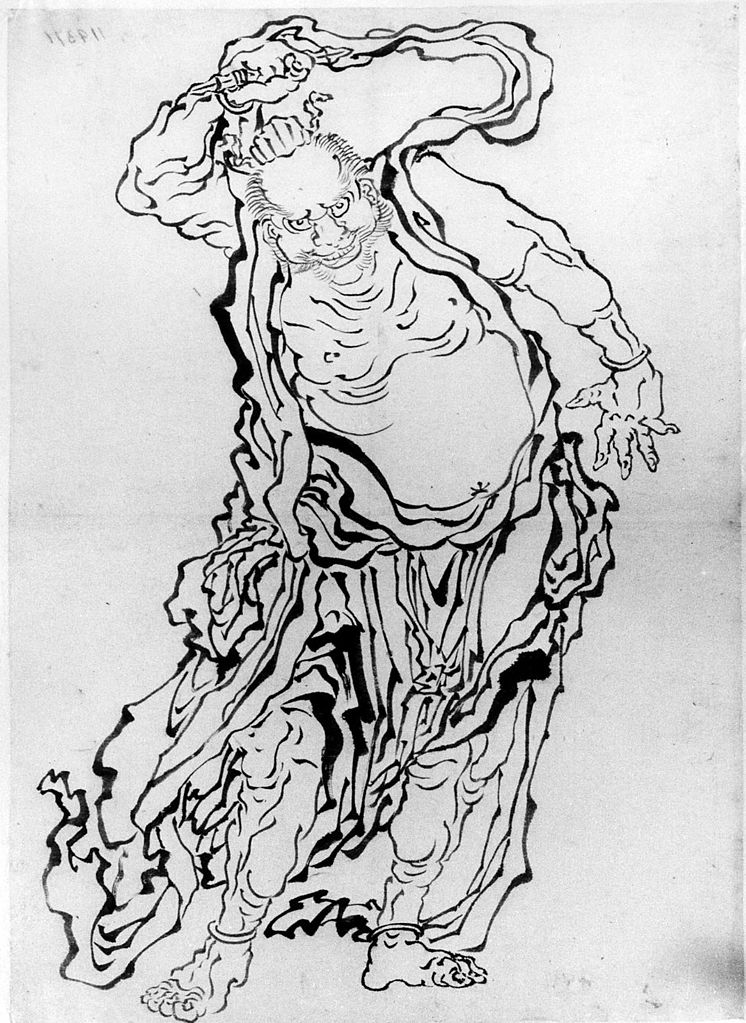
Ōi examined the statues. They were beautifully carved and masterfully assembled from many pieces (the seems invisible to untrained eyes). There were two unfinished statues of Buddha, four small statues of demons cowering on the ground (the types that are usually depicted under the feet of the "Heavenly Generals"), and last but not least, a magnificent statue of a Niō - one of the guardians who are usually set up in pairs at the gates of temples.


Ōi has heard about Unkei's mobile sculptures, so she examined one of the demons in detail. She soon found a little hidden switch, which, indeed, set the automaton into motion, and the demon crawled around on the floor. However, as it was making too much noise, Ōi switched it off. As the noise faded away, some other sounds were heard from the side of the entrance area.

Before going back, they quickly investigated the room that opened to the right from the hall. It was a sleeping room, all in disorder. Among the things, Kitsune Oba-san found a scroll, which she identified as a magic scroll for paralyzing any creature (Hold Monster).

Then they went back to the entrance area, and checked the two other doors. One was sealed. Ōi broke the seal, and the investigators entered what seemed to be an office. However, before they could search the room, out of the dark corners came crawling and leaping --- severed human hands!


The hands caught the investigators by surprise and attacked them. One each latched onto Ōi and Kitsune Oba-san, but more were approaching. The two ladies acted wisely, and fled, sliding the door shut. After some struggle, they successfully broke free from the painful grasps of the hands and crushed them.

Next, they checked out the last remaining door in this area. It was stuck and had to be forced open. It led to a long corridor with two doors - one sealed (leading to the office with the animated hands), and one regular. There were also scratch marks on the floor, showing that something heavy was recently dragged into the second room.

The second room turned out to be a storage, with half-finished statues, barrels, unworked wood. Ōi's attention was drawn to a big statue, that depicted a Niō guard, identical to the one in the dining hall, but with its legs violently broken off. As she leaned in closer, the statue suddenly came alive!!! "No, no, please, don't hurt me!" it begged. And then it regaled the tragic story of master Unkei's experiments...

Not satisfied with just mechanical movement, Unkei turned to magic to bring his statues to life. His latest creation were two twin guardians: one was peaceful, but the other - evil incarnate! The evil twin attacked the good one and tore off its legs, then attacked master Unkei. The sculptor is either dead or dying, perhaps somewhere in this house... And the evil twin is still here, too...

Ōi promised to return and repair the guardian's legs. But first, they set out to explore the rest of the house and the cellar.

Fearing an attack from the evil guardian, they ran to the trapdoor and climbed down the ladder. Down there, it was moist and smelled like wet clay. The floorboards of the cellar were creaky and unstable. Ōi lifted one of the boards and found that there was a storage of wet clay beneath. So they proceeded carefully, so that they don't fall into it.

A nasty surprise came, however. The trapdoor above them slammed shut! Then there was the sound of something heavy being dragged over it. The investigators were now trapped in the dank cellar!

They opened the door to the next compartment of the cellar. By the lamp light, they saw a figure slumped against the wall - master Unkei! The sculptor screamed in fear and shouted some strange commands - and to this, four lumps of clay animated and attacked Ōi and Kitsune Oba-san. Kitsune Oba-san obliterated one clay-mation monster with a precise hit of her umbrella. Ōi managed to convey to master Unkei, that they came to rescue him. The sculptor called off his little clay monsters.

Unkei was badly injured, dying. Still, his first reaction was suspicion, especially when he found out that Ōi was a sculptor's daughter and a sculptor herself. Unkei was sure that she came to steal trade secrets. He was also quite fatalistic, sure that they would all die down here or die by the hands of the evil guardian. He asked the investigators to just go ahead and kill him.

Kitsune Oba-san noticed two more doors in the cellar, one regular and one reinforced with iron. She asked Unkei where those led, but Unkei snapped and told them that they were not allowed to go through either of them. Kitsune Oba-san got fed up with the sculptor's secretiveness and cast Sleep on him...

Ōi eagerly jumped over to the reinforced door. The door had several warnings written on it, like "Stay out!", "Don't much my stuff!", "Deadly!". The door also had an unusual metallic handle. Despite all the warning signs, Ōi grabbed the handle and slid the door open - and at the same time a small needle sprung out from the handle. Ōi could feel the burning sensation of poison through her body and fell unconscious, foaming from the mouth!


Kitsune Oba-san checked the second cellar room, and found several molds for small bronze statues and a clay vessel full of money. She took only 5 yens, but also pocketed a nice mold.

She tried to do first aid on Ōi, but failed. She tried again, but failed, and this time the lamp, her only light source, went out.

So, in the complete darkness, she slowly made her way back to the ladder and climbed up to the trapdoor. With an extreme feat of strength, she managed to push it open and slightly push back the furniture (a chest) that was blocking it. She climbed out - and a spear flew out of the darkness, barely missing her head. Then the evil guardian statue came charging and tried to crush Kitsune Oba-san by pushing the chest against her. The old lady, miraculously, withstood the pressure, and jumped on top of it.

Kitsune Oba-san wanted to use the scroll of Hold Monster, but realized that it was too dark to read it...

She avoided another hit from the statue, and then, like in an action movie, she jumped through one of the nearby walls - a simple paper screen. She made it through unscathed, and, luckily for her, ended up in the courtyard of the house, illuminated by moonlight. For some reason, the statue didn't, or couldn't follow her, but retrieved the spear and threw it at her, missing again!

Kitsune Oba-san unrolled the scroll and uttered the incantations...

But, against all odds, the statue made its save!

Kitsune Oba-san ran out from the yard and circled around the house. On the street, she ran right into the patrol, three city guards with lanterns and clubs. She told them that master Unkei's house was beset by bandits, or rather, one very strong bandit. The master sculptor and his guests were in grave danger.


The guards followed Kitsune Oba-san back to the yard and the house.

The statue wasn't in the room... So Kitsune Oba-san asked two guards to stand ready, while she and the third guard went down to the cellar to retrieve the wounded captives. The guard picked up Ōi's body and went back up - only to find his comrades locked in combat with the evil statue! The statue killed on of the guards with a single blow. The guard with Ōi's body ran out to the courtyard as quickly as possible.

The one remaining guard heroically stood his ground and even managed to chip off a piece of the evil statue.

Kitsune Oba-san made it up the ladder and attacked the statue as well. The guard put down Ōi's unconscious body and re-joined the fight... They fought, and Kitsune Oba-san was taken out by the statue's hit. The two remaining guards valiantly managed to bring down the statue...

Ōi and Kitsune Oba-san woke up at home, tended by a doctor. They were lucky enough to survive. Master Unkei lived as well...

Monday, March 9, 2020

ALCHEMY! A system for weird experiments


An alchemy system, written for this month's RPG Blog Carnival!

The following tables present a subsystem for alchemy in OSR games, taking LotFP as the base (so, all prices are in silver standard – if your game uses gold standard, just replace “sp” with “gp”). For Laboratories, see LotFP: Rules & Magic, p. 82-83.
The system is intentionally convoluted and baroque. Like any good old alchemy, it is untested, volatile, and unpredictable! Use it as written, or just steal ideas from it, as usual! Have fun!


Sunday, December 22, 2019

[Secret Santicorn!!] All Aboard the Terrible Dogfish!

For this year's Secret Santicorn, Deus on the OSR discord server requested "a pirate ship, stocked with treasure, captained by something supernatural"

Without further ado...

(click to download as .pdf)

a weird pirate adventure with a supernatural captain and treasure... Have fun! Happy holidays!


Sunday, July 22, 2018

Downhill Race - a cheese-rolling contest minigame


Need a merry and possibly deadly folk festivity for your setting’s rural areas? Why not consider the famous Cooper’s Hill Cheese-Rolling race at Gloucester?

I wrote up some rules for a minigame for a cheese-rolling contest player characters can enter, and, possibly, win.

There are two eerie alternative outcomes of the contest too, for that weird horror touch.


Have fun!!!


Wednesday, July 18, 2018

[LotFP] Extended laboratories for research


This post is a collection of things a high-level wealthy Magic-User can use to stock her laboratory and library. This is mostly for flavor, extending and fleshing out the abstract approach of the Lamentations of the Flame Princess rulebook (p. 80-83). With a distinct early modern science feel.

Cabinet of curiosities

No laboratory can be complete without a nice collection of curiosities! 

Strange creatures
Creatures preserved as skeletons or taxidermic mounts can be added to the cabinet of curiosities. The preparation of such objects requires special knowledge and skill. For taxidermy, the corpse must be relatively fresh (1d6 days after death). For skeletal mounts, most of the bones must be present.
Where to find: Collected personally or purchased from adventurers.
Price & value: Depends on the type and hit dice of the creature.

Type
Price & value / hit dice
Common
50sp
Exotic
100sp
Supernatural
250sp

Samples
Minerals, gems, jewels, crystals, stones, metals and ores, various substances (resins, oils, liquids, etc.); and also seashells, corals; butterflies, insects.
Where to find: Collected personally or purchased.
Price & value: If the value is not evident, set it as 1d10 x 10sp.

Medical oddities
Specimen displaying signs of illnesses, pathologies, malformations. Usually preserved in fluids, displayed in glass jars.
Where to find: Purchased from medical facilities, collectors, unfortunate parents...
Price & value: Depends on the rarity and state of preservation: 2d10 x 25sp.

Exotica
Curios and various objects from faraway lands. Masks, costumes, jewelry, paintings, drawings, dolls, puppets, idols, art pieces, musical instruments, anything.
Where to find: Collected personally or purchased from merchants, travelers, agents. Good connections with trading companies can give the opportunity of first picks from any haul…
Price & value: Calculated based on the distance the object had to travel to get to the collector. Add 1d10 x 10% on top of that for agents’ fees (only added to the buying price, not the value).

Distance & complications
Price & value
For every 100 miles over 500
50sp
Transportation included both land & sea
+100sp
The original owners of the object would kill to get it back
+100sp

Laboratory equipment

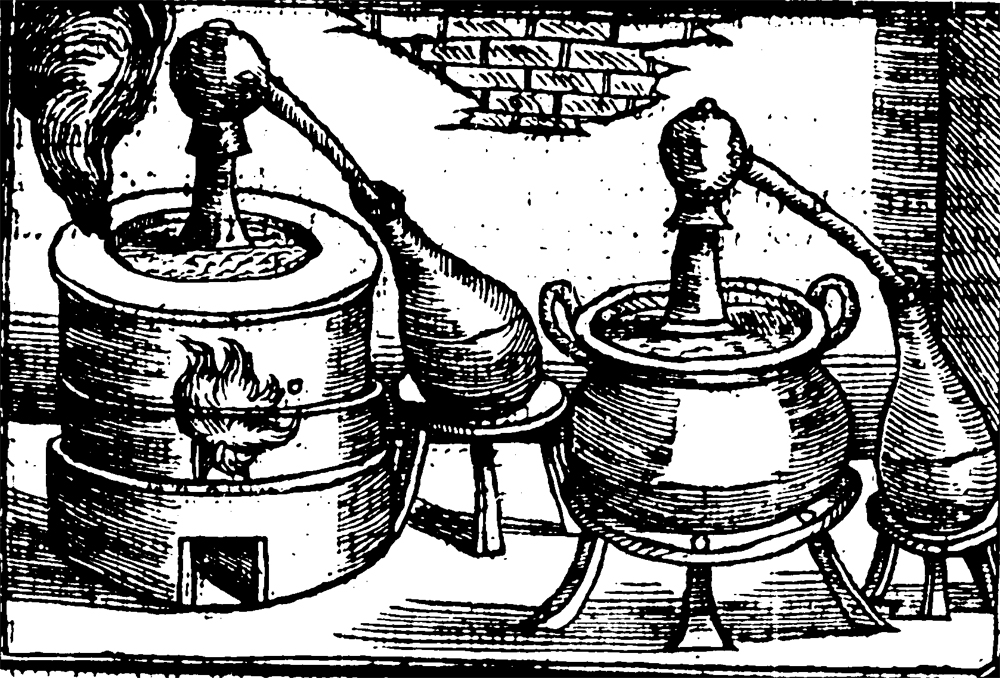
A well-equipped laboratory must include a wide range of vessels, both simple and complex, which can be used for sublimation, distillation and other processes. Including, but not limited to:
  • alembic – two vessels connected by a tube, used for distilling chemicals
  • aludel – clay subliming pot, made up of two parts
  • athanor – a special furnace that provides uniform and constant heat
  • crucible – a small vessel or container that can withstand high temperatures
  • “Moor’s head” still – distillation apparatus, with an extra vessel for cooling water
  • mortar – for grinding up various substances     
  • retort – spherical vessel with a long neck, protruding downwards
Where to find: Most of the equipment is available for purchase only in major cities. Some pieces are produced on special orders.
Price & value: Any amount of money can be invested into this sinkhole…

Extended and specialized laboratory spaces

These rooms are counted towards the value of the laboratory as usual, but might give situational advantages (a bonus on the Magic save, etc. – Referee’s discretion).
Additional space is a one-time extra, counted over the base space requirement of a 10 feet square / 1000sp value.


Additional space required
Price & value
Anatomical theatre
50 feet square
>3000sp
Animal kennels
none
100-500sp
Botanical garden
20 feet square
500-1000sp
Ä Hothouse, greenhouse, orangery, conservatory
20 feet square
>1000sp
Observatory
50 feet square (tower or top floor)
>5000sp

Special implements

Additional space required
Price & value
Calculating devices
none
>2000sp
Printing press
10 feet square
>1000sp


Wednesday, July 11, 2018

[Magic Item/Book] Tome of Higher Constellations

The Tome of Higher Constellations was created by an anonymous scholar in Prague, for the library of Rudolf II. The first half of the book consists of astronomical tables: meticulously compiled and corrected, but nothing out of the ordinary. However, the second half introduces more charts, graphs, from a wide range of sciences natural and occult. Through complex calculations these are cross-referenced with the heavenly constellations. Uncanny patterns, otherwise hidden, emerge… making it possible to trace and predict the finest shifts of the celestial spheres that command the fate of the whole universe. The final result is a single date in the future, when all factors align, and major, cosmic changes are possible. Actions undertaken on that day will bear major consequences: warlords bent on world domination crave to know this date, alchemists and magicians seek it as the date of their opus magnum or most complex ritual…

The catch: this prognosis is not descriptive. It’s prescriptive. Once a date is divined using the Tome of Higher Constellations, something world-changing is bound to happen. But the exact details are malleable. Anybody who knows the time can attempt some insane endeavor.

To peruse the Tome, one must have a strong academic or arcane background, and then spend 2d4 weeks working on the calculations in a library or laboratory.

After the period of study, a date in the future is predicted.


Dice type
Time unit
1
1d4
days
2
1d6
3
1d8
months
4
1d10
5
1d12
6
1d20
years

Roll two d6’s and consult the chart. The first d6 gives a dice type. The second d6 gives a time unit. A roll with the given type of dice defines the amount of time units.
Example: roll #1 is 3 = 1d8. Roll #2 is 5 = months. The 1d8 roll comes up as 6. This is combined as 6 months.
Repeat this process two more times, then sum up all the results to learn how far into the future will the grand constellation take place, counted from the FINAL day of work with the Tome.
Example: #1 = 6 months; #2 = 8 days; #3 = 12 years. The constellation will take place 12 years, 6 months and 8 days into the future.
If one time unit comes up more than once, just add them up as usual.
Example: #1 = 6 months; #2 = 13 months; #3 = 2 days. The constellation will take place 19 months and 2 days into the future.


Yeah... This is how I envision "epic level" games in LotFP, mwhahah...

Monday, July 9, 2018

[Actual Play] The Belly of Gargantuel playtest [LotFP]

Ignore the whale penis.


Ran The Belly of Gargantuel for two friends. They rolled up two characters each, a level 2 and a level 1. The game was set in the Baltic area in the 17th century, just as a basic historical background.

Characters: They are a small group of amoral con-artists: Isaiah Spielmann, the con-artist (Specialist 2), Klara Moroz, Isaiah's bodyguard (Fighter 1), Jebediah Smith, self-proclaimed prophet (Cleric 2), Pupa, Jebediah's discipline (Dwarf 1)

During their travels, they stopped in a small nameless village. In the morning, there saw the locals gathered before the inn. They were all listening to a small boy, who was telling about a gigantic dragon fish monster carcass which lays in the field. He found a valuable gold medallion in the monster's mouth, and saw some more treasures - but he had to retreat because of the rancid rotten smell. The village elder took away the gold ("this belongs in the orphan support fund!").

Jebediah Smith went into fire and brimstone mode, and proclaimed that the appearance of the carcass is the Devil's work, and must be investigated. Jebediah's miracle worker prophet cred was supported by Klara, who said that Jebediah healed her brother. In the end, a small mob of seven villagers joined the expedition.

The boy led the party to the rotting sea monster. However, they stench of decay was so overwhelming, that they couldn't even get close (vomiting and Constitution losses all around...). Jebediah Smith managed to improvise protective masks out of rags and various herbs - enough for eight people.

The PCs and four villagers approached the hulking mass of flesh from the side of its maw. They broke some teeth to create a gap to crawl through. Inside they searched the flotsam and produced some valuables, but decided against lingering for too long. They turned their attention to the "throat" instead. They found a fishing net which was clearly set up intentionally to block the opening.

A villager was the first to pass through the throat muscle... and got crushed by it to near-death. After some experiments, the players learned they can "trigger" the muscle from the safe distance (suing a scythe brought along by one of the villagers), then quickly jump through.

In the first belly, they found a copper tube with a tap inserted into the flesh of the creature. Jebediah opened the tap and gathered some of the oily substance into his palm... and gave it to Pupa to try. Ever-obedient Pupa tried it, but spit it out instantly, announcing it to be like lamp oil. The players used their vessels and waterskins to drain the contents of the oil cistern, with the intent to sell it later.

They proceeded to the next "room", and found that a huge gaping wound in the side of the creature was opening to this place - an entrance/exit point they haven't noticed earlier.

A big chest was found in the place. Instead of opening it, Klara began to haul it outside, but she got attacked by a kelp monster, which lay in ambush... One of the villagers panicked and ran out through the wound. The monster slashed open Klara's veins with its razor sharp leaves. The rest gang upon the weird monster and valiantly fought it. Isaiah fired his arquebus, almost deafening everybody in the vicinity... Jebediah panicked and fired his crossbow into the melee, and hit Klara, who collapsed to the ground. Pupa noticed that the creature had a single orifice on its body, and with a lucky roll buried his sword inside it. The monster hissed and died.

Klara was brought back to life by Jebediah's healing spell: but as they neglected to remove the crossbow bolt first, it essentially got fused with her body! The players found two more monsters, but in a dry and passive state.

The exploration of a third belly revealed more signs of habitation, including a hammock. Jebediah crawled into the hammock to rest, giving orders to the others to search the room. Isaiah spent some time reloading his arquebus.

Pupa found some muscly meaty flaps on one side of the belly, which could be folded back like curtains.

Behind them, there were hidden niches.

In the middle one, there was a treasure trove. When it was opened, crustacean creatures swarmed out of it! They climbed up on Pupa, and two of them even managed to crawl under his armor... and started slicing and cutting him with their claws. Pupa fell to the ground and started rolling over, trying to remove his armor or crush the crustaceans. Meanwhile, Klara and the villagers crushed a few more. Eventually the colony of creatures retreated into the shadows. Also, the meat of the crustaceans turned out to be edible.

The players continued exploring the hidden niches behind the belly's lining.

In the left one, they found a huge wooden statue depicting a siren: a figurehead, from a ship's nose. Although it was clearly something valuable, the players decided to leave it behind due to its great weight. However they did remove a golden crown from the statue.

Finally, they opened up the last compartment, and found a skeleton overgrown with corals, and a naked man with a long beard! The man held a harpoon and was shouting obscenities at the characters, calling them thieves and robbers. Pupa understood the language the man spoke, and tried to learn more about him. The man had lived in the belly of the monster (which he named Gargantuel) for many decades, and lost all memories prior to that time. His only companion was another man called Donato: the coral-encrusted skeleton was actually Donato, and the niche was a burial shrine. He objected strongly to the characters stealing his stuff, of course... but turned out that the highly amoral Jebediah Smith had an even viler plan! Jebediah decided to seize the man, and show him in a religious themed sideshow of sorts: come, see the modern Jonah, who lived in the belly of a whale for 40 years! Of course, he told the villagers, that freeing this man is a pious act... so they all quickly overpowered and bound the poor fellow.

The group left Gargantuel's carcass through the big wound. We decided to wrap it up at this point. Hopefully soon we will pick this up, and see whether they can get all the treasure or will be forced to donate it to the village's "orphan support fund".

I have to say, the players got extremely lucky with the encounter rolls. On the other hand, they did miss out on searching some parts of Gargantuel more thoroughly...

Overall, it was a fun little session.


Saturday, June 30, 2018

Healing potion ideas

I'm not a fan of instantaneous magical healing in fantasy RPGs. I want it to be witchcraft, with consequences and weird side-effects. The same goes for healing potions: I find the standard "drink-and-recover-1d8-points" or whatever solutions bland. I tried to come up with some interesting potions to offer to my players. Some of them are connected to a pseudo-historical 17th century setting, but not necessarily.

Relieving dew
This simple folk ointment is applied to the person's wounds before rest, and tied over with bandages.
Ingredients: honey, butter, assorted herbs and plants like yarrow, elderberry, etc., mixed and fermented for a week in a copper vessel.
Price: low. Requires recipe.
Effect: During the resting period, the normal healing rate is doubled. However, the strong sweet smell of the ointment attracts insects. A LOT of them. ALL of them. There is a 1-in-6 chance that it attracts not only the natural fauna of the area, but also some sort of a strange, exotic, or supernatural creepy-crawly as well... The smell lasts 24 hours.

Weapon salve
This is based upon a real practice. According to the theories of sympathetic magic, a connection is formed between the wound and the weapon that caused it. The healing of the wound is accelerated by applying the salve on the weapon, not to the wound.
Ingredients: skull lichen (moss from the skull of a hanged man), urine, gypsum, pine resin. Before application, add the blood of the wounded to the salve.
Price: moderate. Requires special knowledge and recipe to create.
Effect: If this is accomplished, during the next rest period the wounded person recovers as much hit points, as the standard damage of the weapon (roll for it).

Green blessing
Invented during the "Tulip mania", this solution is used by florists to increase the life-span of their beloved bulbs. However, as usual, the pesky adventurers found an alternative use for this serum!! Turns out, when sprinkled on a fresh open wound, it induces the growth of a weird plant scab, which fuses with the person's body, closes and heals the injury.
Ingredients: petals of exotic tulips (at least three different colors), sulfur, various salts, etc.
Price: very high. Requires special knowledge, recipe, laboratory.
Effect: 1d6 rounds after application, the wounded person recovers 1d12 hit points.
Then save against Poison. If failed, the scab continues to grow rapidly. It takes 10 rounds for the plant to completely cover a human adult. Each round it does 1 damage to the person, and gains +1 hit point. To stop the spreading, the plant has to be reduced to 0 or less hit points. Any damage is divided equally between the plant and the infected person.
On the 11th round, if the plant still has at least 1 hit point, the infected person dies.


What kind of healing potions do you use?


Go!