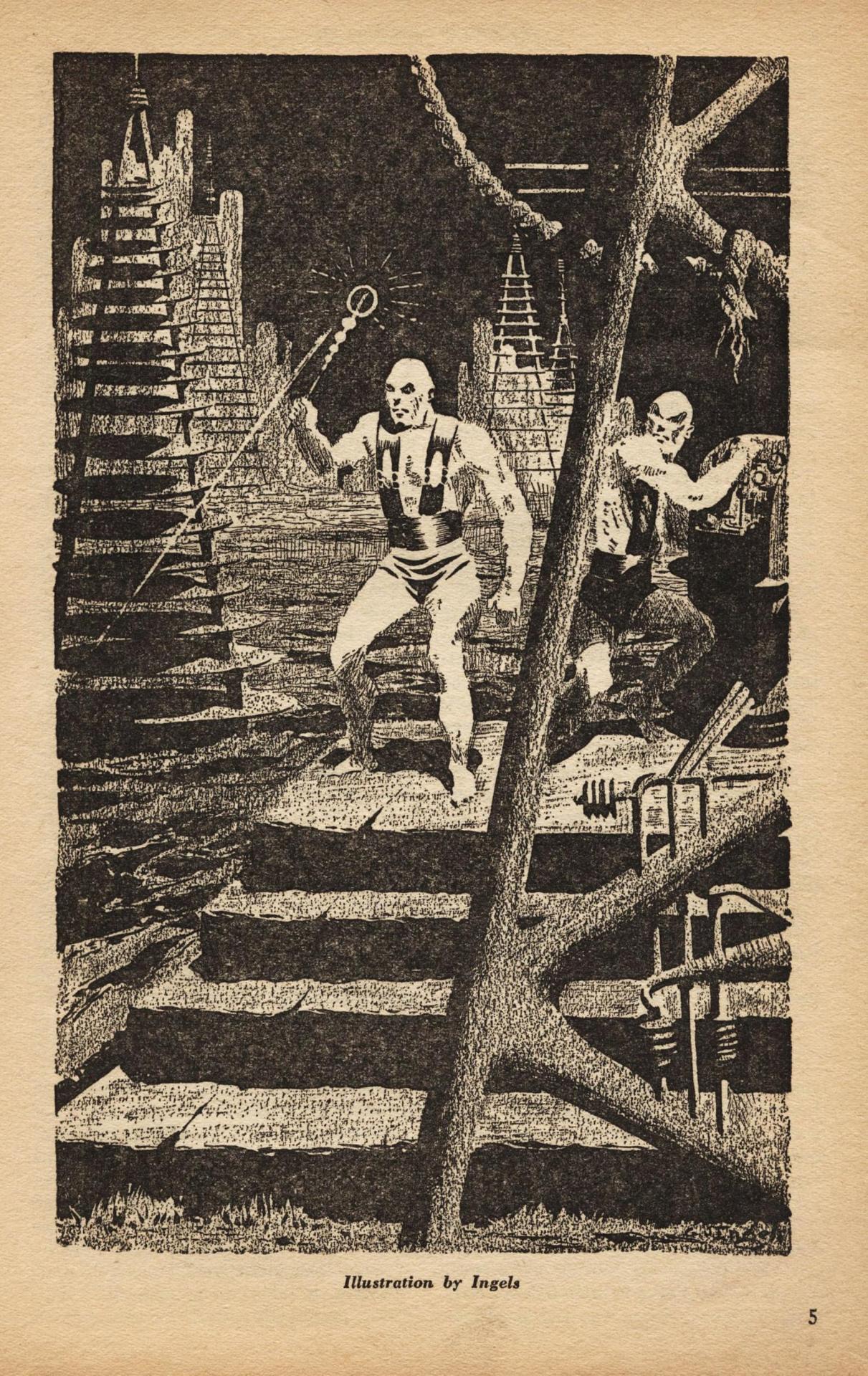
Showing posts with label Leigh Brackett. Show all posts

Tuesday, November 11, 2025

Appendix N for The World of Tomorrow

The World of Tomorrow, our science fantasy campaign, is pretty much built with a kitchen-sink approach. The initial pitch can basically double as the Appendix N: “moebius jodorowsky tangerine nightmare oranssi mutant pazuzu heavy metal barsoom carcosa acid police surf”

The main rules are: If it could be published as a DAW book or an ACE Double… if you can imagine it on a sick space/psych/prog rock album cover… if there is a conspiracy theory about it… then it fits.

Due to its eclectic and expansive nature, I could probably list off every piece 1960s-1970s sci-fi and dystopian fiction and every krautrock album ever. But that would defeat the purpose. So I will try to limit myself to a couple of key entries for each category.

Books: the biggest influence is Fred Saberhagen’s “Empire of the East” series. It’s chock-full of COOL SHIT that you can steal for your post-apoc sci-fant games. “The Elephant”? A must. Radar stations as scrying magic. Nuclear demon lords and their satraps. Good stuff. Read them if you can. The main protagonist is kinda bland… But the world is great. Add Lin Carter, Leigh Brackett, Poul Anderson's early stuff...

Movies: oh boy… Logan’s Run, Planet of the Apes + Beneath the Planet of the Apes, 2001: Space Odyssey… Hard to narrow this down. Phase IV too, for sure.

Comics/art: yeah, Moebius is the big one here. No explanation necessary. Mike Grell's Warlord, another great hollow earth weird fiction title. A lesser known entry would be the stuff from Planet Comics, in particular "The Lost World" which ran in #21-69 (1942-1952).

Other RPG stuff: McKinney’s Carcosa (I use a bunch of tables for robots, weapons…), Gamma World, Mutant Crawl Classics – actually, from these last two, I borrow very little specifics, but definitely lean into the same atmosphere.

Computer games: Fallout 1 & 2, for sure. The most powerful motif for me is the Vault suit, which always marks the wearer as either/or a weirdo, a demigod, a target.

Last, but not least: history/non-fiction… I use my science-fantasy Frankentable extensively, so many characters have names from ancient cultures (Egyptian, Akkadian, Greek…). There are lot of ziggurats, statues, artifacts, stuff that comes from my academic interests. And my non-academic interests in weird shit, conspiracies, cults.


In collage form.


Saturday, April 17, 2021

Science fantasy Harpist class

The science fantasy Harpist class is a character type for OD&D/BX/whathaveyouish games. It is based on the lyrists and bards from pulp fiction, who can manipulate emotions or matter with their music. See, for example, one of the protagonists in "The Jewels of Bas" by Leigh Brackett (I wrote about it in this post), and other appearances of lyres in Brackett's sword & planet fiction. I was also influenced by the description of the "Pipes of Killorn" in "Swordsman of Lost Terra" by Poul Anderson

“It was like the snarling music of any bagpipe, and yet there was more in it. There was a boiling tide of horror riding the notes, men's hearts faltered and weakness turned their muscles watery. Higher rose the music, and stronger and louder, screaming in the dales, and before men's eyes the world grew unreal, shivering beneath them, the rocks faded to mist and the trees groaned and the sky shook. They fell toward the ground, holding their ears, half blind with unreasoning fear and with the pain of the giant hand that gripped their bones and shook them, shook them.” (Poul Anderson, “Swordsman of Lost Terra”, Planet Stories, Nov. 1951)

So basically it's a D&D bard, but with science fantasy flavor for the powers.


Saving Throw vs.

Powers / day

Lvl

Exp

HD

Poison

Wands

Paralysis

Breath

Spells

1

2

3

1

0

1

13

14

13

15

13

1


2

1,500

1+1

12

14

12

14

12

2


3

3,000

2

12

14

12

14

12

2

1


4

6,000

2+2

11

11

11

13

11

2

2


5

12,000

3+1

11

11

11

13

11

2

2

1

6

25,000

4

10

11

10

12

10

3

2

1


Level 1

Level 2

Level 3

1

Charm Person

Deflect Missiles, 10’

Charm Monster

2

Comprehend Languages

Deflect Rays

Confusion

3

Deflect Missiles

Enthrall

Destabilize Matter

4

Identify

Forget

Disrupt Force Field

5

Message

Hidden Message

Heroic Frequency

6

Radionics

Hold Person

Radionics, Group Therapy

7

Sleep

Silence, 15’

Suggestion

8

Ventriloquism

Siren Song

Warm Earth Music for Plants


See the full post for the Descriptions of powers:

Sunday, November 22, 2020

How much D&D can one find in Appendix N?


Obviously, there are a lot of motifs from Appendix N literature in D&D. But how much D&D is there in Appendix N literature? Myriad traces of myriad pulp fantasy/horror/sci-fi works have made their way into the DNA of D&D; but at the same time not many texts feel completely like a D&D session. Which is logical, of course: what works as a game session is not necessarily enjoyable literature. But as an exercise, I thought it would be fun to set up a scale of just how “D&D-like” is a particular text. This is not a score about the literary merits or whatever of the works. It is correspondence to the specific and somewhat arbitrary idea of a D&D session, formulated as:

“A group of adventurers tracks through a wilderness, descends into a dungeon, explores a place of weirdness and wonder, tries to overcome obstacles and monstrous enemies through cunning, martial prowess and magic, retrieves treasure.”

I broke down this description into 10 categories, took three short stories I like, and scored them:


“The Weaver in the Vault” by Clark Ashton Smith (1934)

“The Jewels of Bas” by Leigh Brackett (1944)

“Straggler from Atlantis” by Manly Wade Wellman (1977)

Group of adventurers

1

1

0

Wilderness

1

0.5

0

Dungeon

1

1

1

Weirdness & Wonder

1

1

1

Obstacles

0

1

0

Monsters

1

1

1

Cunning

1

1

1

Martial prowess

0

0

1

Magic

0

0.5

0

Treasure

1

1

1

Final score

7/10

8/10

6/10


“The Weaver in the Vault” by Clark Ashton Smith stars “three of the king’s hardiest henchmen” on a quest to retrieve a mummy from the ruins of a royal tomb. If this isn’t a D&D setup, then what is? The wilderness track is cool, my favorite part is when they rest at the “wayside shrine of Yucla, the small and grotesque god of laughter”. Also, spoiler: it ends in a TPK (they should have thought about party balance! Three fighting-men…). [read it online!]

“The Jewel of Bas” by Leigh Brackett starts out with just two “adventurers” (a bard and a thief!), but along the way they pick up a rag-tag team of outcasts (like an insane hermit and a hunter). The monster section is great: there are low-level mooks (the Kalds), Big Bads (the androids), and even a high-powered NPC. The wilderness is mostly a scenery, not really interacted with. The dungeon is very cool, and there’s lots of weirdness, much of it rather dangerous. [read it online!]

“Straggler from Atlantis” by Manly Wade Wellman has a single main protagonist, which is, of course, not very D&D-like. And he faces the monster without bringing henchmen or torchbearers, the fool! Still, the story (which has a great Odyssey feel) has a small cave dungeon, an interesting monster (alien ooze!), nice NPCs, and a capable cunning warrior. [buy digital/print]