Showing posts with label review. Show all posts

Friday, December 1, 2023

[Review] The Shattered Circle by Bruce R. Cordell (1998, AD&D 2e)

I’m finally taking the time to finish this review, because Jenx told me it’s a good practice to review adventure’s you’ve run. And I agree.
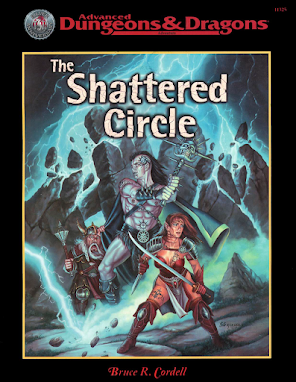

The Shattered Circle is a Dungeon.

It is a pretty solid dungeon.

It is also often overlooked, despite having been written by a pretttty famous designer, Bruce R. Cordell. It came out towards the end-times of TSR D&D (for AD&D 2e), and, among that batch of adventures, it is overshadowed by his works for later editions, or the Sahuagin or the Illithid Trilogies.

When compared to those adventure cycles, The Shattered Circle is different in scope and aim. It’s supposed to be a true adventure MODULE, one that you can easily slot into your own world. So, while I was also drawn to the over-the-top beauty of, say, Cordell’s The Gates of Firestorm Peak, I picked this one when I needed a medium-sized dungeon complex to slot into the 5e campaign I ran back when (there is a Classic Modules Today supplement available). It’s almost setting-neutral. And the dungeon’s connections to the overworld are easy to tailor to your own liking. And you probably should, because the hooks offered in the book are, hmm, underwhelming/uninspiring. However, as this was an on-going campaign, with established conflicts and NPCs, I just modified a couple of things as needed.


--- From here on be spoilers ---


What did I change? Surprisingly little. I put the campaign-driving portal to the Feywild the party was seeking down in the deepest room of the dungeon. I got rid of two or three empty rooms, and the riddle-based tests in one of the areas – I don’t generally like riddles.

What did this leave me with? A lot of fun stuff.

This is a 75-room dungeon, spread out over three levels. The Upper and Lower levels are part of an ancient dungeon complex/arcane laboratory. To keep things varied, they are separated by a middle area, which is a large cave, with one of the best set pieces of this module. There is one main entrance into the complex, but after that there are many passages to follow, with alternative ways of access to deeper levels.

The main sentient creatures are the arachno-humanoid Chitines, split into two opposing factions. You get a lot of variety from the other monsters and wanderers: from the more common undead to freakin dinosaurs and gibbering mouthers. So there is definitely a cool weird tinge to this place. The presence of all of them is explained, and there is ample space in the dungeon between their main lairs, so there is no “monster hotel” effect.

Speaking of ample space: I love it when the cramped corridors of the upper zone give way to the caverns below. And in the central cave, there is the magnificent set piece of the Chitine city, a gigantic spherical mass of webbing suspended mid-air. Comes with a great illustration to boot!!

The dungeon also presents a variety of challenges: from combat through diplomacy to navigational challenges. There is even a flooded sub-zone. One of the challenges is a three-component “key search”, which might feel a bit computer-gamey, but my players actually enjoyed it (and it forced them to face their greatest fear, the aforementioned flooded area, for some cool underwater action).

I ran this from a PDF, and printed out the maps for ease of reference. The publication is overwritten by today’s OSR standards, but many important details are highlighted, and the room keys are structured in a uniform, predictable way, so there shouldn’t be much trouble running it after a read-through of the whole thing. Yes, there is boxed text, generally kept to a sensible length (3-4 sentences), and evocatively written, so I used some of the phrases and sentences as-is. They give a good description of the initial impression the party gets from the room.

Overall, I definitely recommend this adventure. It is a good fit for modern or old-school games, quite versatile, and evocative. The tone veers towards dark fantasy, with some Lovecraftian touches you can emphasize if needed.

Thursday, July 20, 2023

Parallel Dungeons got a review + a cool new series of dungeon deep cuts

Parallel Dungeons, my dimension shifting adventure, got a small write-up by Rowan over at the Dododecahedron blog! He just started up a pretty cool little series called Dungeon Deep Cuts, where he reviews under-the-radar adventures. Sounds like a good way to learn about small, but interesting projects. He is also taking submissions, so, upcoming authors, take note!


Sunday, October 2, 2022

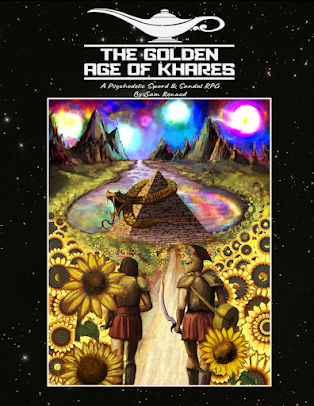
First impressions: The Golden Age of Khares

This is a “psychedelic sword & sandal setting sourcebook”, by Sam Renaud, currently on Kickstarter.

Disclaimer: the authors of the game were soliciting reviews on the OSR Discord server, we got in touch, and they sent me the early PDFs of the books. I was aware of it beforehand, mostly due to the great samples of b&w art that were posted in a classic fantasy RPG illustration group on Facebook. I would have checked out this game anyway, because it’s very much up my alley…


Let me reproduce here the blurb:

“The Golden Age of Khares is a psychedelic sword & sandal setting sourcebook designed for the Tabletop RPG system Low Fantasy Gaming. In it, the Kharesian Empire is described, a fictional bronze age society made up of a collection of city states with a shared culture. The world of Khares is one of sword & sandal high adventure that takes inspiration from old Biblical Epics and Italian Peplum films.”

So, yeah, it’s Bronze Age, it’s peplum, it has weird psychedelic overtones.

I don’t have the capacity to do a full review, so I’m just gonna write up my impressions as I flip through the game test (I’m perusing a PDF with the full text, some art, but no layout yet).

System:

  • Low Fantasy Gaming. I played in two one-shot sessions of this system, because one of my mates is a huge fan of it. It was pretty good, easy to grasp if you know any other D&D-ish thing, etc. The system is not reproduced wholesale in Khares, but there are handy summaries and some additional rules to represent the setting’s unique features.
  • New classes: Boxer (boxing is the main sport/entertainment in the setting), with various martial arts feats; Drone (monster hunter special forces); Magus (sorcerer/witch types); Maqlu (exorcists), Mabed (sorcery-using priests); Nomad (ranger, survivalist); Penthu (healer).


Setting info:
  • The setting gazetteer is about 50 pages long. It’s a solid pulpy not-Mesopotamia with other ancient and medieval West Asian and African stuff thrown into the mix. It’s colorful and diverse, not just Orientalistic cliches, so I’m into it at first glance.
  • I think a summary would be good for these regions, like a table that just lists each region, terrain type, main geographic features, main settlements, trade goods. There are such summaries in the law & order section.
  • Speaking of law & order: I found it somewhat weird, that, while the Kharesian society is progressive in some matters, like LGBTQ rights + there is no slavery, there is still eye-for-an-eye punishment, flogging, branding, death penalty.
  • No world map in these preview materials yet?
  • I love the Kharesian Courirer Parrots. Overall, the section on culture & customs is pretty good, lots of stuff to use here. “There’s a festival today in the city, they eat this and that, and then they gather to watch a boxing match between the champions of two families…”
  • The District descriptions are good. Unlike most of the gazetteer, which is mostly text/narrative, these sections have the gameable bits upfront. Factions, major NPCs, rumors & hooks.


Monsters & Magic
  • I didn’t have time to go through this properly, but at first glance there are Jinn from the Astral Realm, rabisu (sorcery-created monsters), all kinds of spells and magic items, some are reskinned D&D staples, some are unique to the setting, so a good mix.
  • There are monster summaries in the appendix.


Referee tools/guide:
  • Guides for travels, sandbox play, handing out rewards and experience.
  • Yes, there are random generators!
  • Plenty of random tables, wandering monster charts and so in the appendices!!!
  • Random dungeons, called Complexes.
  • There is a tracking sheet for dungeon crawl procedures.


Sample adventure:
  • This is useful: a mini-setting with a starting village and a couple of dungeons. I like the “Tomb of the Vizier”.


Presentation:
  • Very good art! The Kickstarter will add more.
  • The Kickstarter says that editing and proofreading are done, but if the preview document is anything to judge by, then another pass is definitely in order! For example, the sample dungeon talks about a “bismarched Vizier”, the map is labelled with Roman numbers, while the key sometimes refers to Arabic numerals.


Overall, this is a nice book. Maybe too long for my use as-is (I tend to go for a different style of presentation, like big but brief hexcrawls, etc.), but lots of good ideas, imagery, useful tables.
Definitely delivers on the peplum part! As for the psychedelic aspect: there are the astral dungeons and the Jinn, the various types of sorcery, but I’d have to dig into it more to really get the vibe.

Good luck with the Kickstarter!

Friday, November 5, 2021

[Review] A Groats-Worth of Grotesques - a baroque bestiary

Linkhttps://www.drivethrurpg.com/product/357543/A-Groatsworth-of-Grotesques

Full disclosure: I bought this in PDF when it came out, because it’s a historical bestiary and it looked right up my alley! Then at some point the author got in touch with me and offered me a free copy. I told him I already had the PDF, and he was cool enough to send me a complementary physical book! Thank you, G. Edward Patterson III, good sir.

So, here’s an overview/review of this thing!

A Groats-Worth of Grotesques, by G. Edward Patterson III (2021) sets out to bring the fantastic world of baroque bestiaries to the gaming table.

Overall, it contains some 120 grotesques. Each gets an illustration or two (curated from period sources), a description, and a simple stat block (HD, AC as equivalent to armor type, speed “as human” or “as horse” or something similar, brief description of attacks). The descriptions are in a flavorful, baroque style, whimsical, and often give hints on how to use these creatures in-game. There are notes on the margins (in italics, but, luckily, in “printed font”, none of that unreadable “pseudo-handwriting” nonsense).

There are classics as old as ages (Catoblepas! Leviathan! Wildmen!). There are weird creatures, based on partial descriptions or illustrations, supplemented by the author’s whimsical fantasies. Some are “imported” creatures, for example the Haunted Umbrella (at least I think it is an adaptation of the kasa obake). There are “natural” but exotic beasts (Ostriches, Elephants). The “common” beasts like Cats and Dog are given some little twists, as the author retells superstitions of legends connected to them.

There are also a couple of NPCs: Clerics, Fighters, Magi and Rogues. These entries are great, as each class gets a handful of flavorful “subtypes”. The Fighters also stand in as ruffians, for example the Damned Crew are carousing, rapier-wielding bastards. The Chartumim subtype of Magi are “reasoners or disputers upon difficult points in philosophy who have become enchanters and conjurers”, and often serve as advisors to local nobles. There is a baker’s dozen of Rogues. This is VERY GOOD stuff! Instant story seeds & hooks and great for that historical flavor.

The physical book is softcover print-on-demand, pretty easy to use, especially how each monsters gets a separate spread. My only minor complaint is that the digital version is a 600+ megabyte unoptimized PDF – but at least this way you get good quality images and can delight in every cut of the historical engravings.

Overall, I think this book strikes the perfect balance between being an atmospheric and authentic in-setting text, while maintaining actual gameability and content you can utilize when running your campaign.

If you run Lamentations of the Flame Princess – pick this up. If you need some classic (as in “going back to antiquity”) beasts and some weird, interesting monsters for your OSR game – pick this up. It is a delight and a good source of inspiration.

Link: https://www.drivethrurpg.com/product/357543/A-Groatsworth-of-Grotesques

It's $4.99 for the PDF, so, I guess, that's the exchange rate of a groat? Anyway, these Grotesques are definitely worth a groat.

Thursday, February 21, 2019

[Review] Times That Fry Men's Souls


Times That Fry Men's Souls is a campaign setting written by Seann McAnally / Nerd Glows On. The weird historical setting lends it to LotFP, but all stats are presented in a neutral OSR style. The cover says it all: Colonial America + a probability of tentacles... I like it though how the GM can control the amount of supernatural they introduce: the book has many options for "mundane" games, concentrating on drama, espionage, Revolutionary war drama, political intrigue, and frontier exploration; but if needed, a rather hefty dose of the weird/ghastly/supernatural can be injected into this historical world.

Let's see what's inside the book! You get ~130 pages of content, with a single-column layout. There is an "old-timey" feel due to the fonts and well-curated public domain illustrations and collages. Luckily, the historical fonts don't hinder readability.


A short introduction summarizes what you get: a hexcrawl, monsters, hooks, short adventures. The author says that what you don't get is background info about life in Colonial America. This is not necessarily true: in the appendices there are 15 pages of tables with useful info (names, random background tidbits, random NPCs, locations, meals...). Also, there is a reading list in the end, so you can use those recommendations to supplement world-building. The Colonial Gothic RPG has most things covered. If you run or play "Times That Fry...", I think it's necessary to brush up a bit on your knowledge of the period, at least in general terms, to know who the factions are, what are they fighting for.

Also, bonus points for including music recommendations - this list is short (only three entries), but effective, especially the doom folk of The Widow's Ride. I love compiling playlists for the games I run, so I appreciate this part! Off the bat, I'd add Crow Tongue to this list!

An 80-strong hex crawl makes up the bulk of the book. There are two maps: a full-color at the back cover for the players, and a "control map" inside for the GM. The map is a piece of real historical cartography - great for immersion - but when in grayscale, I think it lacks contrast (the white hex grid blends with parts of the map). And sometimes it's hard to discern whether a marking on the map actually corresponds with the hex description. It's still usable, though. And you can easily extract the map from the pdf, and adjust brightness/contrast in any photo editor.

Crawl-procedures are presented next: travel speed, conditions, weather effects (by season).

The territory is densely populated with story hooks, factions, encounters. Luckily, there is a single-page overview of the various storylines, so the GM can easily see to which hexes each narrative strain is tied.
There are also several categories of interest, e.g. lists of all hexes containing treasure, all hexes containing supernatural encounters, or all locations with military activity.
Such summaries are very important for hexcrawls. Of course, you have to test this in actual play to see just how well Seann managed to organize it, but it looks solid and useful. Perhaps it'd be beneficial to also highlight the "trigger hexes" for the storylines? An overview of these storylines and their importance for the campaign (and the consequences!) would help a lot, too. You have some page-turning to do going back and forth between hexes to learn the whole plot.

Next: hex descriptions!

The layout is great here: one hex = one page.

Each hex has two or three things. It is not stated explicitly, but from what I understood, the first thing is something that's visible right away when entering the hex (or maybe even visible/heard from a neighbouring hex). The subsequent things are harder to discern, and are only encountered when the players spend some time exploring the hex.
The first thing is usually an encounter with people or wildlife. The encounters are quite varied, and also very interactive. Many of them "trigger" the story threads mentioned above. Some are shorter, e.g. a young doctor who asks to be escorted from one hex to the other. But there are also complex stories, arching over 4-5 distant hexes.
Hexes also contain places of interest, natural or man-built, abandoned or populated, loot, items, etc.
One hex occupying one page REALLY helps. Descriptions are terse, and easy to skim (although some highlighting would be beneficial). Stats for NPCs and creatures are summarized at the end of each entry.

The hex contents are VERY GOOD. They perfectly evoke the historical period, provide enough details, and, most importantly, hooks and things to interact with.
It's interesting to see how the author deals with hex 307 - The City of New York... Understandably, there is only so much you can fit in a single page. So there is no detailed description, but you still get two small locations, and, of course, the hook for one of the most convoluted story threads in the campaign.

In keeping with the setting's "adjustable weirdness level", these hexes only contain mundane hooks and happenings.

However, in the next section, there are ten weird tales of the supernatural that the Referee can drop on their players.

Each weird tale is presented on two pages. They are not tied to exact hexes, but there is a general recommendation on where to locate them (e.g. "close to a river"). There are no maps or mini-dungeons, though, so if a "cave" is mentioned, the Referee has to make their own.

The tales ( = short adventures, probably a session each?) are mostly dealings with a group of local populace followed by an encounter with a weird and possibly highly lethal entity. They have this distinct Call of Cthulhu feel, which is great, but the formula is a bit repetitive (arrive to hex, learn about weird stuff from disgruntled local folks, run away or deal with said weird stuff). Two tales stand out, however, which provide a different approach: one is a surreal party in an urban setting (good thing to put in that underutilized New York!); the other tale is triggered when one or more party members die.

The book closes with several tables and appendices, which I've mentioned before.

Highlights: evocative historical setting with an adjustable weirdness level, good layout and art, dense hexcrawl (there are no "empty" spaces!), plenty of hooks and stories for the players to interact with. It can be played both as a straightforward historical game, or a weird investigative horror that truly tries & fries your soul!

Overall, I really like Times That Fry Men's Souls! I definitely want to run it eventually. If you want a historically grounded campaign, with plentiful weird opportunities, you should get it too. Great for OSR systems (and especially LotFP), but certainly usable with Colonial Gothic or Call of Cthulhu too.


Monday, October 29, 2018

[Review/Overview] The Stygian Library by Emmy Allen


Emmy Allen released a new book, The Stygian Library. Emmy's stuff is always great (I'm really looking forward to trying the ice age weird fantasy, Wolf-Packs & Winter Snow), and, of course, she is the author of The Gardens of Ynn, which I'm a big fan of.

The Stygian Library follows the same structure: it is a procedurally generated environment, with plenty randomness, but also with a strong thematic coherency at the same time.

The Library is made up of randomly generated locations (mostly rooms). The player group begins on Depth level 0, then move deeper and deeper. For each step, the DM rolls a Location and a Detail, combines them. The Depth rating is always factored into the generation of the next room, so the Stygian Library gradually opens up, and the players are able to reach the more obscure and weird places.

There are also randomized Events and Encounters with the inhabitants of the Library. The Bestiary is quite extensive, full of library-themed creatures: animated books, origami golems, dust elementals, and, of course, the Librarians: they are divided into five color-coded orders, each with its own set of duties, spells, abilities.

I really dig the atmosphere and the tone of this setting. This is how Emmy describes it in the introduction:
Whilst some of the contents in this book can be portrayed in a rather dark light (it is, fundamentally, about necromancy), it’s not intended as a particularly grim setting. One thing that often strikes me about the fiction I enjoyed in my youth is how the dark and the whimsical so often go hand in hand. Not as a subversive contrast, but rather how the imagination (when allowed to wander) will flit between ideas that fill us with wonder and with dread. Like exploring an empty house, all it takes is a slight change in context (nightfall, say) to make the experience creepy.
So, The Gardens and the Library are built using the same principles, There is one major difference between the Gardens and the Library. Ynn is all about exploration, wonder and adventure. The Stygian Library offers the same "sense of discovery", but it is also vast (potentially infinite) repository of knowledge, so it is very likely the player characters visit it with a specific goal in mind.

Emmy presents a simple, but elegant subsystem for tracking the players' progress towards their goal. There is a Progress score, its initial rating is tied to the highest Intelligence rating in the group. The score increases if the group talks with somebody knowledgeable, or finds a book about the topic they are researching, etc., and decreases if the party is lost or misinformed. The DM sets the difficulty of finding the information (e.g. 20 for basic knowledge, 35 for dangerous obscurities). If the Progress reaches this value AND the group is deep enough into the Library, the precious information is found.

Furthermore, the presence of the Librarians, their active and engaged factions, also gives the Stygian Library a different, more "narrative" style, than the slightly more passive, dreamy, utterly lost inhabitants of the landscapes of Ynn.

So, overall, I think The Stygian Library is not only a great follow-up to The Gardens of Ynn, but also presents its own developments.

The only minus is that the .pdf is still just a simple text, without any hyperlinks or bookmarks... This book would benefit ENORMOUSLY from a well-marked structure. For example, it'd be great to be able to click a header on the Location Table, and be taken to the description. Maybe something for a future edition?

Get the Library here, it's $4. And check out this hilarious mind-bending play report!


Sunday, May 20, 2018

[Review] Dark Island one-page dungeon

A couple of weeks ago I wrote a comment on Christopher Tamm's amazing blog, Elf Maids & Octopi, which was picked as "comment of the week", and I got a gift - a small pocket-mod style one-page dungeon / zine. As far as I understand, he also posts these dungeons on his patreon.


The dungeon is the lair of the Dragon Queen, located on an island in the middle of an underground lake. It's a massive rock, riddled with holes, passages, caverns and halls. The Dragon Queen is still around, but she is not the fierce conqueror and tyrant she used to be... nowadays, she is this whimsical, nostalgic creature, who wanders around her domain, likes to talk to visitors, invites them to her table (sometimes eats them, though)...

There is a very nice map with an encounter table (nowadays the island is mostly populated by lizards, gnomes and other subterranean folks). Inside the pocket-mod, there are brief write-ups of the various "factions" standard behavior, and some details like special treasure.

I like this little dungeon. It can be easily taken and used in some other context: e.g. as an "overland" island somewhere in the middle of the ocean, with the underground themed monsters reskinned as something else. Some preparation is needed to stat everything up.

Wednesday, November 23, 2016

[Bloody Basic] Weird Fantasy Edition review/overview

I've been aware of John M. Stater's work for some time, but never got around to actually check out anything. His main design is the OSR title Blood & Treasure, for which he created a basic version, called Bloody Basic. Bloody Basic is a whole line of shorter books, each containing the essential rules for character creation and playing with slight variations, but presenting a different setting and race/class choices. There's a book for classic fantasy, a "contemporary" edition (contemporary meaning something like steampunk? I haven't read this one, it has "automatons, drakkens" etc, but also "fighters, sorcerers, clerics and thieves", so I don't know how different it is from the classic book), a fairy tale supplement (the brilliantly titled "Mother Goose Edition") and Sinew & Steel (promising a more realistic medieval setting). And there is a last one, which I have:

Bloody Basic: Weird Fantasy Edition

What I like about this book is that it strives to capture the atmosphere of weird fiction without or even before pulp. The short two-paragraph preface is wonderfully dense, evocative, and it provides a very strong statement. Stater stresses the origins of the weirds in the Romantic Movement:
"[Weird fantasy] has in its genes both pseudo-historical romances, Orientalism and fairy tales, though not fairy tales fit for children. The fairy tales that parented weird fantasy were never stripped of their violence or their erotic overtones.
Weird fantasy is both steeped in meaning and bereft of it. It is quiet and noisy and ridiculous and sublime."
His main touchstones are Lord Dunsany and Clark Ashton Smith, although I feel Dunsany is the stronger presence here. At the visual side of things we get Beardsley and Sidney Sime, who are not just "public domain illustration sources", but major influences.

Sidney Sime. Hothrun Dath.
For Lord Dunsany's "Gods of Pegฤna"

So in the end, we arrive at a game of Donjons & Decadence.

Yes, Stater substitutes "donjon" for "dungeon". And there are many-many more quirky words scattered around the book. There is even a handy Thesaurus so that you can spice up your language with appropriately archaic words. "You can call a gemstone blue, but there are many other fine words to use in its place," including, but not limited to "aqua, azure, beryl, cerulean, ceil, cesious, chalybeous, cobalt, cyan, ecchymotic, gentian"... Why call a temple simply a temple, when you can instead refer to the local "chantry, chapel, church, cloister, convent, conventicle, dagoba, deanery, dewal, dogobah, fane, fold, friary, glebe, holy place, house of [god], house of prayer"... This is all quite hilarious.

The game rules are OGL-based, with the standard six attributes. There are only three types of modifiers, 0, -1 and +1, for average, below average and above average ratings. These apply to "tasks" (tests rolled with 1d20), attack rolls, etc.

I love how the description of polyhedral dice is illustrated by Bragdon's "Sinbad, in the desert, discovers the Five Platonic Solids"!

Things get more interesting with Races! Humans are humans (although their appearance in a fantastic world can differ from ours). Elves are graceful, soulless and hedonistic. Grotesques are humanoid with one or more exaggerated or bestial feature, eccentric loners who are often slaves to their passions. The fourth available player race is Satyrs from the Greek myths. The difference between a Grotesque and a Satyr probably lies in their perception of their own "deformities" - a Grotesque wants to be a human (I'd totally go White Wolf with this race), while a Satyr is just fine, pass on the wine.

The Classes are re-skinned and slightly modified versions of the classics. Clerics become Idolators. "Turn Undead" is now "Shunning" (and can be used against any enemy of the idolator). Spells are called orisons and are gained by becoming initiated into one or more of the nine mystery cults (each initiation comes with an extra taboo!). Overall, there aren't many such orisons: a total of 30 (10 per level), and each cult gives access to basically just one spell in each tier.

The Magic-User class is renamed Magus, who cast "cantraps". As usual, the magi get a significantly wider array of spells: a total of 52 cantraps. Stater's love of new names is in full swing here as well: "Ken Gibberish" for "Understand Languages", "Eldritch Bolts" for "Magic Missile", and so on.

The Fighter is called the Puissant. They get feats and the usual combat bonuses. It comes as a surprise to see the simple Thief as the last class... :) Their lowly designation is spiced up by two possible subclasses, the Demimond and the Odalisque.

The Three Witches from Orson Welles' "Macbeth" (1948)

The Game Master advice section is generic, but the Monsters return to the flamboyant style. The Weird Tales rule supreme here: there are tentacled aberrations, gibbering mouthers, but also standard fantasy and old-school RPG beasts. Stater, obviously, uses the authentic spelling of "gnole". There are also listings for scrolls and magic items (including the "Masque of the red death" and the "Silver key" for breaching dimensions).


Overall, this is a wonderful little game. The use of archaic words might not be everybody's cup of tea... But I have to point out, that when it's needed, Stater writes in a comprehensible way, rules are kept clean & clear, they are easy to learn.

Personally, I think this game would be even better if it relied less on the old-school RPG canon! I would love to see more interesting "cantraps" and "orisons" which are not just renamed D&D spells. 

Tuesday, October 18, 2016

[Apes Victorious] A review/overview

First of all, why was I so stoked about Apes Victorious? I've been planning/dreaming to run games set on "a planet ruled by apes" for quite a long time, quite possibly using Mutant Future as the backbones, but I always had the problem of having to spend a lot of time and effort statting up various simians and mutants and stuff. Apes Victorious takes this burden straight off my shoulder and presents me with an opportunity to run such a game out-of-the-box. 

In this post I will sum up my first impressions as I read the book.

("We shared your ancestors, you kept us caged like monsters...")

The Foreword set the nostalgic tone of the whole enterprise. I like the personal tone Dan Proctor takes here. Also - RIP, Steve Zieser...

Sections 1 introduces the post-retro-futuristic setting - briefly and to the point.

Section 2 is about character creation, and it's a gold mine. As I've mentioned in one of my previous posts, I thought Apes Victorious would be for Mutant Future. Instead, it's modeled after Starships & Spacemen, a game republished (reanimated!) by Goblinoid Game. I think this is a good choice: Mutant Future (Gamma World) is more on the vibrant gonzo science fantasy side, while Starships & Spacemen if a better fit for the bleak, dystopian sci-fi of Planet of the Apes. 

The main game mode is a reproduction of the movies and focuses on astronauts accidentally returning to an Ape-dominated planet. Playing as apes and mutants is an option as well.

Astronauts are well-rounded characters, with additional knowledge in various scientific areas. The Astronaut class covers also the humans who never got off the planet, but instead went into cryogenic sleep and wake up in the world of tomorrow!!! Then we are onto them dirty apes! The strict caste system of Planet of the Apes lends itself very well to conversion into RPG classes. Bonobo Agents are the sneaky / diplomatic ones, Chimpanzee Scholars are the scientists exemplified by Dr. Zira and Dr. Cornelius (obviously, there are also the not-so-humanistic researchers!), who specialize in one or another branch of ape science. Gorilla Soldiers are the leather-clad brutes riding horses and wielding whips and rifles... Fearsome foes, but also an interesting opportunity to play as a character... So are Orangutan Politicians, with their insider knowledge and intrigues.

Humanoids are the "natives", the devolved humans - low on intelligence, but true instinctive survivors. Then there are the Underdwellers, the psionic mutants from Beneath the Planet of the Apes. They also have access to special futuristic pieces of equipment, like powerful energy weapons.

Overall, this is all great stuff!  The options presented here allow you to explore basically any facet of the franchise. For example, I'd love to play a game about simian intelligentsia, taking cues from Soviet history, with dissidents and conformists and closed science cities.

"I'm just a humble ape, please, leave my family alone."
I think it might also be interesting to mix different types of characters in the party. Astronauts and Humanoids go together well, and any renegade Simian can join them as well. Loyal Apes are harder to mix with non-loyals, but these unlikely mixes give us interesting opportunities as well. I think I will make a table of various options...

Section 3 describes the various Psi Powers. I'm not familiar with Starships & Spacemen, but I suspect this section mostly overlaps with it. It's the tried & trusted fare of ESP, telekinesis, brain drain stuff, 12 powers in total. Not much, but it covers most things, and, frankly, coming up with new ones would take it too much towards "magic spells", and ruin the atmosphere of the game.

I've only skimmed Section 4, Adventure Rules. Good to see it has mechanics for "Nets in Combat" and mounted apes -- those pesky humanoids don't stand a chance!!

Section 5 describes creatures you encounter on the planet. These are mostly more dangerous and lethal versions of real world animals. It's interesting to see that there are "wild", semi-evolved versions of apes included. If "the Ape Master wants to add a more fantastical element to the campaign", she can turn to the Forbidden Zone: simian cyborgs, heavily mutated flora & fauna. 

Section 6 is a write-up of Ape Society. Just a few pages, which I find great. Pulling from various sources of the franchise, Proctor presents a quite concise view of the Ape Society, describes their science, religion, tech (remember, chimps, no electricity!). I think this is the best way to do it - without going into superfluous detail. Section 7 goes underground and describes the Underdweller society in the same manner, with a heavier emphasis on technological gizmos and just a few words on the ideology.

Section 8 is for the Ape Master. First and foremost Proctor addresses the problem of the narrow scope of Ape Victorious. 
"After all, as the Ape Master, how many times can you start the game by saying, “You are stranded astronauts, having just awoken from cryogenic slumber...”?" (p. 88)
This is just the kind of intelligent, self-reflective approach I wanted to find in this game! Proctor, once again, briefly, but in clear wording, talks about the influence of the late 1960s-1970s on the aesthetic and the atmosphere of this game. There are quite a few scenario ideas, handy tools like random generators for locations, names, encounters; some commentary on "mixed groups"... Section 9 implements these ideas and is an introductory/sample adventure. Section 10 is conversion options.

This write-up almost turned into a review, so it's time to summarize my thoughts.

I can say that Apes Victorious definitely lived up to my expectations! It has everything I wanted to see in it, it all seems practical and highly usable; a stand-alone niche game for people who love Planet of the Apes. And I think it has the potential to appeal to non-die-hard fans as well.

The writing is top-notch. Brief, to the point, yet personal. Formatting and layout is clean and readable. There aren't many illustrations (maybe 15 pictures for 120 pages?), all done by Mark Allen. This isn't eye candy... but it's easy on the eye. I think the book could have taken more pictures, and maybe included other artist (not that I have any problem with Allen's style - and it's a good fit for the theme). But it's a conscious laconic approach.

Well done, everybody! Can't wait to try this game in action.