Showing posts with label ancient Near East. Show all posts

Sunday, October 2, 2022

First impressions: The Golden Age of Khares

This is a “psychedelic sword & sandal setting sourcebook”, by Sam Renaud, currently on Kickstarter.

Disclaimer: the authors of the game were soliciting reviews on the OSR Discord server, we got in touch, and they sent me the early PDFs of the books. I was aware of it beforehand, mostly due to the great samples of b&w art that were posted in a classic fantasy RPG illustration group on Facebook. I would have checked out this game anyway, because it’s very much up my alley…
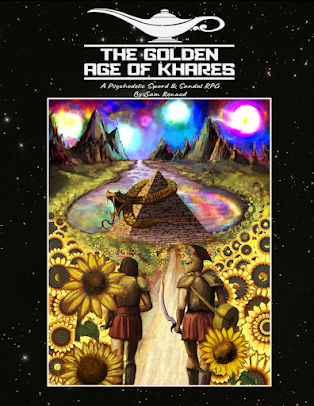


Let me reproduce here the blurb:

“The Golden Age of Khares is a psychedelic sword & sandal setting sourcebook designed for the Tabletop RPG system Low Fantasy Gaming. In it, the Kharesian Empire is described, a fictional bronze age society made up of a collection of city states with a shared culture. The world of Khares is one of sword & sandal high adventure that takes inspiration from old Biblical Epics and Italian Peplum films.”

So, yeah, it’s Bronze Age, it’s peplum, it has weird psychedelic overtones.

I don’t have the capacity to do a full review, so I’m just gonna write up my impressions as I flip through the game test (I’m perusing a PDF with the full text, some art, but no layout yet).

System:

  • Low Fantasy Gaming. I played in two one-shot sessions of this system, because one of my mates is a huge fan of it. It was pretty good, easy to grasp if you know any other D&D-ish thing, etc. The system is not reproduced wholesale in Khares, but there are handy summaries and some additional rules to represent the setting’s unique features.
  • New classes: Boxer (boxing is the main sport/entertainment in the setting), with various martial arts feats; Drone (monster hunter special forces); Magus (sorcerer/witch types); Maqlu (exorcists), Mabed (sorcery-using priests); Nomad (ranger, survivalist); Penthu (healer).


Setting info:
  • The setting gazetteer is about 50 pages long. It’s a solid pulpy not-Mesopotamia with other ancient and medieval West Asian and African stuff thrown into the mix. It’s colorful and diverse, not just Orientalistic cliches, so I’m into it at first glance.
  • I think a summary would be good for these regions, like a table that just lists each region, terrain type, main geographic features, main settlements, trade goods. There are such summaries in the law & order section.
  • Speaking of law & order: I found it somewhat weird, that, while the Kharesian society is progressive in some matters, like LGBTQ rights + there is no slavery, there is still eye-for-an-eye punishment, flogging, branding, death penalty.
  • No world map in these preview materials yet?
  • I love the Kharesian Courirer Parrots. Overall, the section on culture & customs is pretty good, lots of stuff to use here. “There’s a festival today in the city, they eat this and that, and then they gather to watch a boxing match between the champions of two families…”
  • The District descriptions are good. Unlike most of the gazetteer, which is mostly text/narrative, these sections have the gameable bits upfront. Factions, major NPCs, rumors & hooks.


Monsters & Magic
  • I didn’t have time to go through this properly, but at first glance there are Jinn from the Astral Realm, rabisu (sorcery-created monsters), all kinds of spells and magic items, some are reskinned D&D staples, some are unique to the setting, so a good mix.
  • There are monster summaries in the appendix.


Referee tools/guide:
  • Guides for travels, sandbox play, handing out rewards and experience.
  • Yes, there are random generators!
  • Plenty of random tables, wandering monster charts and so in the appendices!!!
  • Random dungeons, called Complexes.
  • There is a tracking sheet for dungeon crawl procedures.


Sample adventure:
  • This is useful: a mini-setting with a starting village and a couple of dungeons. I like the “Tomb of the Vizier”.


Presentation:
  • Very good art! The Kickstarter will add more.
  • The Kickstarter says that editing and proofreading are done, but if the preview document is anything to judge by, then another pass is definitely in order! For example, the sample dungeon talks about a “bismarched Vizier”, the map is labelled with Roman numbers, while the key sometimes refers to Arabic numerals.


Overall, this is a nice book. Maybe too long for my use as-is (I tend to go for a different style of presentation, like big but brief hexcrawls, etc.), but lots of good ideas, imagery, useful tables.
Definitely delivers on the peplum part! As for the psychedelic aspect: there are the astral dungeons and the Jinn, the various types of sorcery, but I’d have to dig into it more to really get the vibe.

Good luck with the Kickstarter!

Sunday, April 25, 2021

RPGs set in ancient Mesopotamia, a non-comprehensive overview

This is a post about Mesopotamian roleplaying games, games that specifically take place in the ancient Near East, although often in a fictional / fantasy-influenced version of it.
 
Elements of Mesopotamian myth and history have been present in wargames and roleplaying games from the beginning. Lammasu as a monster/creature appears in print as early as 1975, in Dungeons & Dragons IV: Greyhawk (and you can find Shedu in D&D VI: Eldritch Wizardry (1976)). There are sections on “Babylonian Mythos” and “Sumerian Mythos” in Deities & Demigods (1980).
However, I am unaware of any early games specifically dedicated to historical or historical/fantastic roleplaying in Mesopotamia. Such existed for Egypt, e.g. 1983’s Valley of the Pharaohs. Even for game lines where “historical supplements” were released for many different eras, Mesopotamia had not received coverage (there is GURPS: Egypt, but no GURPS: Mesopotamia).
 
Two books were released in the early 2000’s, in the so-called “d20-era” (when the owners of Dungeons & Dragons introduced the “Open Gaming License”, allowing the publication of third-party materials building upon the game).
 
One of these is Testament: Roleplaying in the Biblical Era (2003). The book, of course, includes a lot of historically based information and game options from Israelite, Canaanite, Egyptian, and, last but not least, Mesopotamian cultures. The authors sum up their approach to the material as such:
“<…> we are striving to capture the spirit of the Bible. We’re trying to portray the general characteristics of the Biblical characters: Samson is really strong, Moses is a miracle-worker of incredible power, David is a poet as well as a warrior, and angels are great and terrifying creatures.
We interpret the source material metaphorically. In other words, the Bible doesn’t tell us that Israelites physically battled tempter devils, or sphinxes, or other mythical monsters, or that seraphs transformed into fiery serpents (although there is etymological evidence to suggest that they could), but adding these features makes the game more playable.”


The second book is Ancient Kingdoms: Mesopotamia (2004). It’s similar to the aforementioned game, as it includes big chunks of geographical and historical information, and then presents options and mechanics on turning this into a roleplaying adventure. You all will probably recognize how Wooley’s reconstruction of the Ziggurat of Ur is used in one of the dungeon adventure maps. If Testament is biblical, Ancient Kingdoms: Mesopotamia leans more into the pulp/Lovecraft/Chariots of the gods side (“Atop the great ziggurat, on a moonless night, they called down an entity that the stone tablets named Yuthla-Nogg and described as a black wind with a thousand eyes”).


Also based on the Dungeons & Dragons Open Gaming License, but released later is the monumentally titled Babylon on Which Fame and Jubilation are Bestowed (2016). This is a very different beast. It is the self-published work of a sole author (G.P. Davis). It is very strongly grounded in historical research: the introduction states that middle chronology is used, and that the game as intended takes place in the 25th year of Hammurapi’s reign. The previous two books were more like popular encyclopedias of the ancient Near East. This game goes into scholarly detail. There is diacritics! To this background, the more or less standard elements of Dungeons & Dragons are added. There is also a second edition, which changes the game system to an original one, but I haven’t checked it out yet.
Also, do check out the solo play reports on the alea iactanda est blog! (Addendum: this game uses the 2nd edition)


Next up is Blood & Bronze (2016). The stated intent is to present Bronze Age adventures in the pulpy sword & sorcery style, in “Mythical Mesopotamia”. Robert E. Howard, Clark Ashton Smith, and peplum movies are cited as influence. This is a “lighter” affair, that does not include much encyclopedic detail about historical Mesopotamia (its “gazetteer” is 5 pages, compared to the 150-200 pages of the aforementioned examples – but then, recent game design principles are quite different from those of the early 2000’s).


And there is another recent minimalist addition to Mesopotamian roleplaying games, called Into the Bronze (2020). Even more than Blood & Bronze it aims to create an eclectic pulp literature feel: “You and your friends will play as adventurers in a fantastic world 4000 years before Christ. Among its influences are Sword & Sandals movies, Anouar Brahem records and the Jewish Book of Judges”.

This is it for now. This is not a complete list, of course, so feel free to add or discuss in the comments.

(I posted this text originally in a facebook group dedicated to popular references to the Ancient Near East)

Wednesday, November 18, 2020

d30 ancient Near Eastern treasures

Adapted from the list of wedding gifts that Tushratta, king of Mittani, gave to Amenhotep III, as dowry for princess Tadu-Hepa. From the Amarna letter EA22 (The El-Amarna Correspondence. A New Edition... p. 160-183). Modified as needed...

  1. Whip, overlaid with 5 shekels of gold. A large banded agate is inserted into the pommel. A banded agate seal is strung on it.
  2. Horse adornments, genuine banded agates mounted on gold: 88 stones per string. 44 shekels worth of gold.
  3. Set of bronze torques.
  4. 12 good, sharp arrows.
  5. Iron-bladed dagger; its haft decorated with ebony calf figurines, overlaid with gold; the pommel is of a precious stone. 6 shekels of gold has been used on it.
  6. Longbow, overlaid with 4 shekels of gold.
  7. Iron mace, overlaid with 15 shekels of gold.
  8. Pair of gloves, trimmed with red wool.
  9. Two multicolored shirts.
  10. Horse-shaped bottle, made of iron, with eagles of gold and genuine lapis lazuli as inlays. 300 shekels in weight.
  11. Golden fly whisk (3 shekels in weight), along with its linen cloth.
  12. Hand-bracelet, of iron overlaid with gold, adorned with lapis lazuli bird inlays. 6 shekels of gold has been used on it.
  13. Necklace with 35 genuine lapis lazuli stones, 35  dark red translucent stones, and one genuine banded agate in the center; all mounted on gold with a reddish tinge.
  14. Head-binding, of gold, twisted like a torque. 14 shekels in weight.
  15. Spoon, overlaid with lapis lazuli and dark red stones; its handle – an alabaster female figurine, with lapis lazuli inlays. 6 shekels of gold used on it.
  16. Pair of leather shoes, studded with gold ornaments. Its buttons are of a translucent dark red stone. 13 shekels of gold have been used on them.
  17. Pair of shoes, of blue-purple wool. Ornaments of gold and a genuine lapis lazuli inlay in the center. 4 shekels of gold.
  18. Garment of blue-purple wool, Hurrian-style, for the city.
  19. City shirt, Tukriลก style, and a pair of red wool sashes.
  20. Spear of bronze, with a double overlay of gold (10 shekels worth).
  21. Helmet container, of malachite, overlaid with 4 shekels of gold.
  22. Plaque with winged disks and Deluge monsters, of ebony, overlaid with 30 shekels of gold.
  23. Set of salt containers, in the shape of bull-calves and lions, of a dark red stone.
  24. Silver brazier, 66 shekels in weight.
  25. Ebony chest without a lid, adorned with a winged disk and overlaid with 2 shekels of gold and 40 shekels of silver.
  26. Colored loincloth.
  27. Pair of wool leggings.
  28. Stone container, with myrrh-scented oil.
  29. 20 arrows to be shot flaming.
  30. Shield, its middle overlaid with 10 shekels of silver.